

What the New Protein-Forward Recommendations Mean—and Why People Are Talking
For decades, Americans have been told a familiar story about food:
Eat less fat. Limit red meat. Choose low-fat dairy. Base your meals around grains.
And now – suddenly – that story is being rewritten.
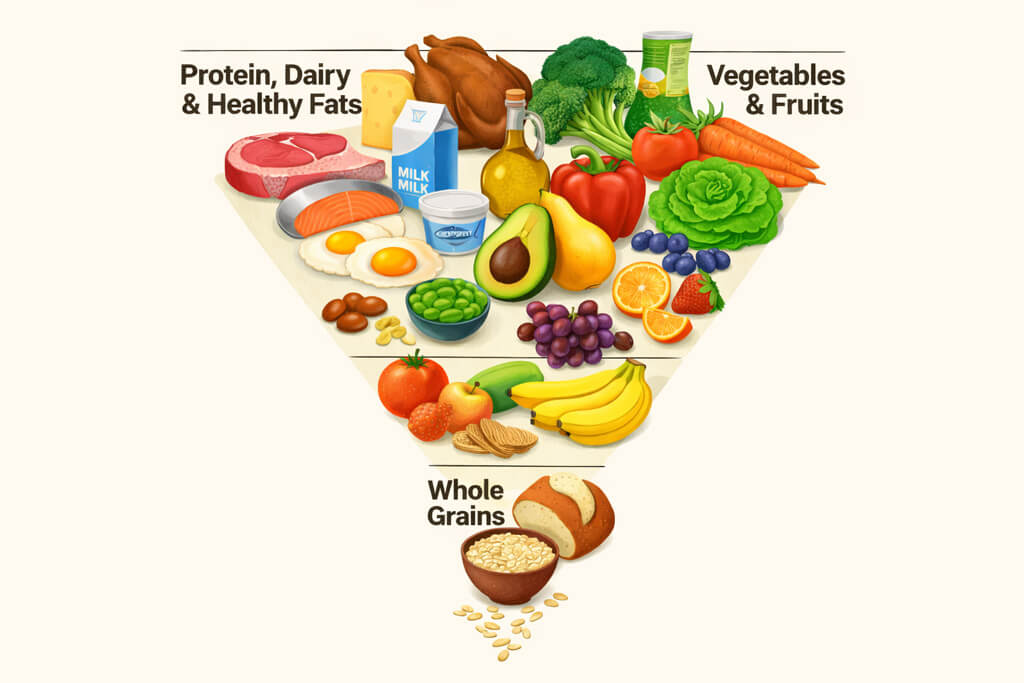
Earlier this month, the U.S. Department of Health and Human Services unveiled a new set of dietary guidelines that turns the traditional food pyramid on its head. Protein, dairy, healthy fats, vegetables, and whole foods now sit at the top. Highly refined carbohydrates and ultra-processed foods are pushed to the margins.
It’s a major shift. And it’s sparking a lot of conversation.
What Changed in the New Guidelines?
According to reporting from NPR, the updated guidelines emphasize:
- Protein and healthy fats as foundational – not something to avoid
- Whole foods over highly refined or packaged options
- A dramatic reduction in foods high in added sugars, refined carbs, and chemical additives
- A more flexible, less prescriptive stance on fat – particularly saturated fat
- Stronger language around limiting ultra-processed foods
The visual update is striking: an inverted food pyramid where meat, dairy, vegetables, fruits, and healthy fats are prioritized, while refined grains and processed foods sit at the smallest point.
Whether you agree with it or not, one thing is clear: this is the most significant reset of U.S. nutrition policy in decades.
Why Protein Is Back in the Spotlight
Protein has long been a controversial nutrient in public health messaging. While it’s essential for muscle, metabolism, hormone production, immune health, and satiety, it’s often been overshadowed by low-fat or calorie-centric advice.
The new guidelines argue that protein – particularly from whole food sources – was wrongly discouraged in prior decades, while highly refined foods quietly became dietary staples.
That’s not a small claim.
It challenges the idea that reducing fat alone leads to better health outcomes, especially in a population where over 70% of adults are overweight or obese and metabolic disease continues to rise.
Why Not Everyone Agrees
As expected, the shift hasn’t gone unchallenged.
Some nutrition experts and organizations point to decades of research linking excess saturated fat intake to cardiovascular disease. Others argue that plant-based proteins should be emphasized more heavily than animal sources.
At the same time, emerging research complicates the picture – particularly around dairy. Multiple large studies now suggest that both low-fat and full-fat dairy can be part of a heart-healthy diet, with fat content playing a smaller role than once believed.
In other words: the science isn’t as simple as we were taught.
And that complexity is exactly why this conversation matters.
Ultra-Processed Foods: The Quiet Common Ground
One area where experts largely agree?
Highly processed foods are a problem.
The majority of calories consumed in the U.S. now come from foods that are engineered for shelf life, hyper-palatability, and convenience – not nourishment. The new guidelines stop short of using the term “ultra-processed,” but they clearly call for a return to real food that nourishes the body.
That alone represents a meaningful cultural shift.
Where MariGold Fits Into This Conversation
At MariGold, we’re not here to tell you what to eat – or to align ourselves with any one ideology.
But we are deeply interested in food that:
- Delivers bioavailable protein
- Is made from recognizable ingredients
- Supports metabolic health, muscle, gut integrity, and long-term vitality
- Minimizes unnecessary processing
That philosophy has guided our products from the start – long before protein became headline news again.
Why We’re Talking About This Now
We’re entering a year where nutrition narratives are shifting fast. Old assumptions are being questioned. Long-standing advice is being re-examined. And people are asking better, more nuanced questions about food.
That’s exactly the kind of conversation we want to foster.
Not arguments. Not dogma. Just informed, curious dialogue.
Tell Us What You Think
Do these new guidelines resonate with you?
Do they challenge what you were taught about food?
Do you feel relieved, skeptical, validated—or all of the above?
We want to hear your perspective. Comment below!
Referenced Article: https://www.npr.org/2026/01/07/nx-s1-5667021/dietary-guidelines-rfk-jr-nutrition





This is what needed to be done. When grains, less protein, less good fats became the norm is when the obesity problem reared its ugly head. Whole foods and limited carbs are the way to go. Once everybody became hooked on highly processed foods it became an issue and also highly profitable for big pharma. Being the sickest country in the world is not something to be proud of. Hopefully it will turn around. Nutritious food is medicine.