

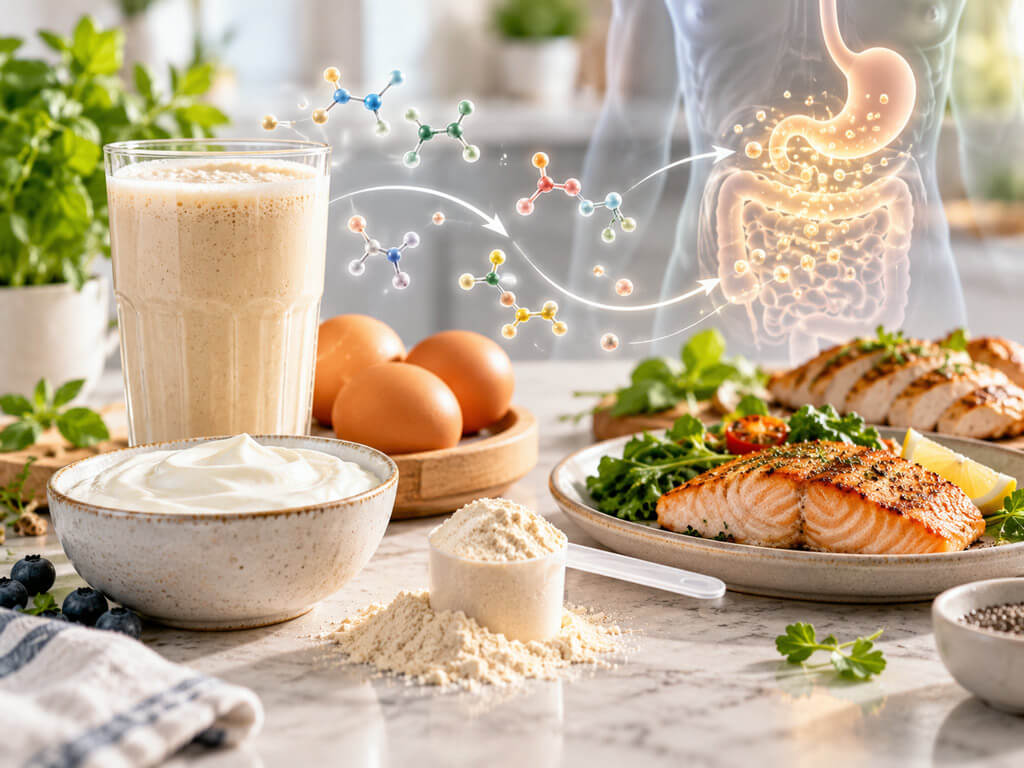
You can hit your protein goal every day, add a scoop to your morning coffee, build meals around protein, and still wonder:
Is my body actually absorbing all of this?
It’s a fair question—especially when you’ve probably heard that your body can only absorb 20 or 30 grams of protein at a time. Anything beyond that, according to the popular version of the story, is essentially wasted.
Fortunately, your digestive system is a little more capable than that.
Your body can absorb considerably more than 20–30 grams of protein from a meal. The more useful question is what happens to those amino acids after they’re absorbed—and whether the protein you’re eating provides the right amino acids for what you want your body to do with them.
That’s where protein quality, protein source, meal size, timing, age, activity level and even what else you eat with your protein start to matter.
First: What Does “Absorbing Protein” Actually Mean?
When you eat chicken, eggs, yogurt, whey protein, collagen or another protein-containing food, your body doesn’t simply send that protein straight into your muscles.
First, it has to take it apart.
Digestion begins in the stomach, where acid and enzymes start breaking large protein molecules into smaller pieces. As those proteins move into the small intestine, additional enzymes continue breaking them down into smaller peptides and individual amino acids.
Those amino acids and small peptides can then cross the intestinal wall and enter circulation, where they become available for your body to use. Most dietary amino acids are absorbed in the small intestine. [Source]
And your body has plenty of uses for them.
Amino acids contribute to much more than muscle. Your body uses protein to help build and maintain enzymes, hormones, antibodies, organs, connective tissue, skin and countless other structures.
So when an amino acid doesn’t end up in your biceps, that doesn’t mean it was “wasted.”
The 20–30 Gram Protein Myth
This is probably the biggest source of confusion around protein absorption.
You may have heard something like:
“Your body can only absorb 30 grams of protein at once.”
That isn’t quite what the research shows.
The idea appears to have grown largely from research on muscle protein synthesis, or MPS—the process your body uses to create new muscle proteins.
Studies have found that somewhere around 20–30 grams of high-quality protein can strongly stimulate muscle protein synthesis under many conditions, although the optimal amount varies according to factors such as body size, age, activity and the type of meal being consumed.
But muscle protein synthesis and protein absorption are two different things.
Research reviewing this question has specifically pointed out that amino acids consumed beyond the amount needed to maximally stimulate muscle protein synthesis aren’t simply discarded. Some may be used by other tissues, contribute to whole-body protein synthesis, reduce protein breakdown, be converted into other compounds or be oxidized for energy. [Source]
In other words:
There isn’t a trap door in your digestive system that opens once you hit gram #31.
If dinner contains 45 grams of protein, your body doesn’t absorb the first 30 and politely escort the remaining 15 grams out.
It digests and processes the meal.
The question is how those amino acids are ultimately used.
Absorption Isn’t the Same as Utilization
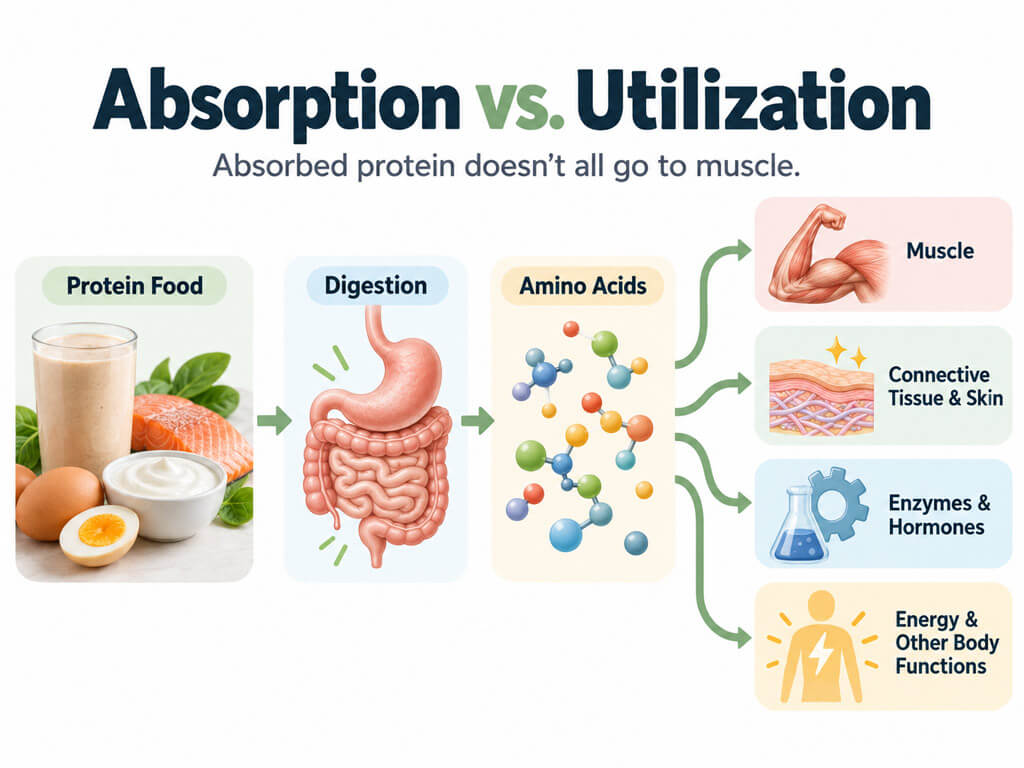
This distinction is important.
Absorption describes amino acids moving from your digestive tract into your body.
Utilization describes what your body does with them afterward.
And this is where the conversation around protein becomes much more useful.
Imagine two protein sources that are both digested and absorbed well. One provides generous amounts of all nine essential amino acids, including plenty of leucine. Another has a dramatically different amino acid profile.
Both can provide valuable nutrition.
But they may not stimulate the same physiological response.
That’s why simply asking, “How many grams of protein are in this?” doesn’t tell you the entire story.
Protein Quality Matters
Proteins are made from combinations of amino acids.
Some amino acids your body can manufacture. Others—known as essential amino acids—have to come from food.
For protein to support muscle protein synthesis especially well, both the amount of protein and its essential amino acid composition matter.
One amino acid gets particular attention here: leucine.
Leucine acts partly as a signal involved in initiating muscle protein synthesis. That’s one reason high-quality proteins naturally rich in essential amino acids and leucine tend to perform particularly well when the goal is building or preserving muscle.
Protein quality also involves digestibility—how effectively a protein can be broken down and its amino acids made available.
Recent research continues to emphasize that protein quality isn’t determined by one factor alone. Amino acid composition, digestibility, the structure of the food and the rest of the meal can all influence how dietary protein is handled by the body. [Source]
Where Whey Fits In
Whey is considered a high-quality protein because it is easily digested and supplies all nine essential amino acids.
It is also naturally rich in leucine.
That combination makes whey particularly useful when the goal is supporting muscle protein synthesis, recovery or simply increasing high-quality protein intake without adding a large volume of food.
Whey isolate goes through additional filtration that removes much of the fat, carbohydrate and lactose found in less-filtered whey products. The result is a concentrated source of protein that can be an easy way to add protein to coffee, smoothies or meals.
That can be especially convenient when getting enough protein from food alone starts feeling like a full-time job.
But What About Collagen?
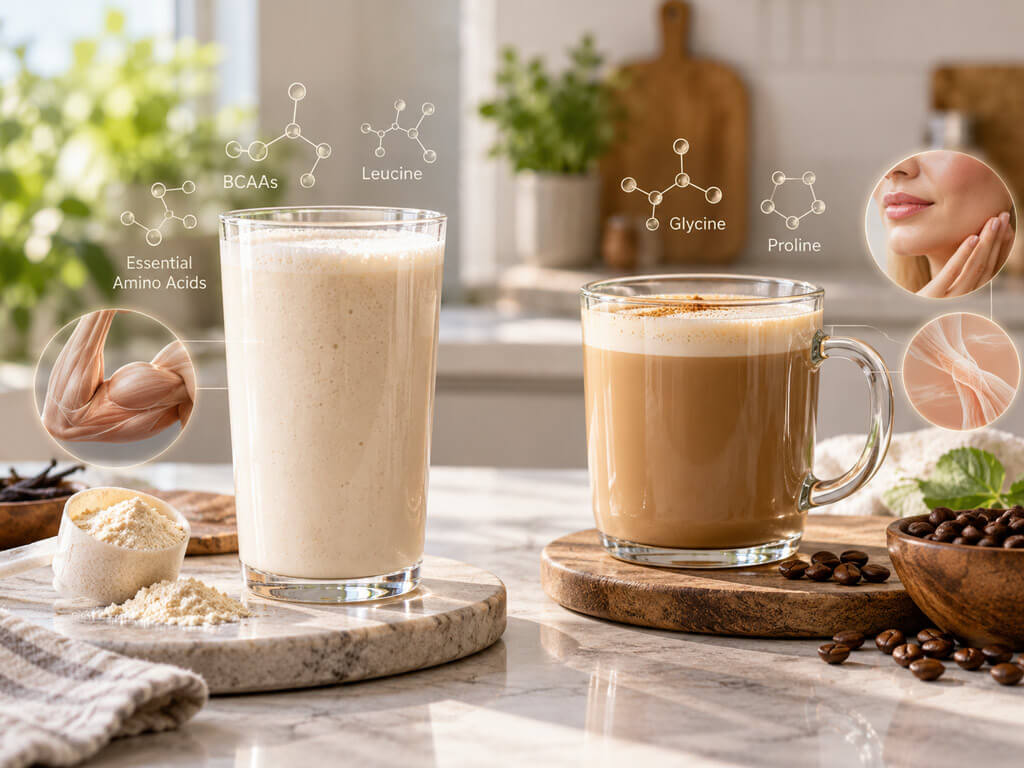
Here’s where protein conversations sometimes get unnecessarily black-and-white.
Collagen and whey aren’t interchangeable proteins.
But that doesn’t make one “good” and the other “bad.”
They simply have different amino acid profiles.
Collagen is particularly rich in amino acids such as glycine, proline and hydroxyproline—the amino acids closely associated with collagen-rich connective tissues.
However, collagen does not contain all nine essential amino acids. It lacks the essential amino acid tryptophan and is therefore classified as an incomplete protein under traditional protein-quality scoring systems. [Source]
Whey, on the other hand, is a complete protein and contains a much higher proportion of essential amino acids involved in stimulating muscle protein synthesis.
So think different tools for different jobs rather than winner and loser.
If maximizing muscle protein synthesis is the goal, whey has a clear advantage.
If you’re choosing collagen because you specifically want collagen peptides and their unique amino acid profile, that’s a different nutritional purpose.
And there’s no rule saying your diet has to choose one or the other.
Does Hydrolyzed Protein Absorb Better?
You’ll often see the word hydrolyzed on collagen peptides and some protein products.
Hydrolysis essentially performs part of the protein-breaking process ahead of time by breaking larger proteins into smaller peptides.
Research suggests that hydrolysis can increase the speed at which certain proteins are digested and amino acids become available. [Source]
But faster isn’t automatically synonymous with “better.”
A slowly digested protein isn’t necessarily poorly absorbed. It simply releases amino acids into circulation at a different rate.
And that brings us to another misconception.
Faster Absorption Isn’t Always the Goal
Protein isn’t consumed in a laboratory.
Usually, we’re eating it with other foods.
A steak eaten with vegetables and potatoes behaves differently in your digestive system than a scoop of isolated whey mixed with water.
Fat, carbohydrate, fiber, food structure and processing can influence gastric emptying and the rate at which amino acids appear in circulation.
Researchers increasingly refer to the food matrix when discussing protein nutrition—the idea that nutrients don’t exist in isolation and that the structure and composition of an entire food or meal can influence how we digest and use them. [Source]
That means a protein that reaches the bloodstream more slowly isn’t necessarily inferior.
Sometimes it’s simply taking the scenic route.
Should You Spread Protein Throughout the Day?
This is where the 20–30 gram conversation contains a useful kernel of truth.
You don’t need to spread protein throughout the day because your body becomes incapable of absorbing it after a certain amount.
But distributing protein across meals may be useful if your goal is to stimulate muscle protein synthesis multiple times throughout the day.
Instead of eating very little protein for breakfast and lunch followed by an enormous portion at dinner, many people may benefit from including a meaningful source of high-quality protein at each meal.
One review proposed roughly 0.4 grams of protein per kilogram of body weight per meal, across at least four meals, as a practical target for people specifically trying to maximize muscle-building responses. That’s not a universal requirement, however, and individual needs vary considerably. [Source]
For everyday life, the takeaway can be much simpler:
Don’t obsess over an imaginary absorption ceiling. Aim for enough total protein and consider spreading it reasonably throughout your day.
That might mean eggs at breakfast, Greek yogurt as a snack, chicken or fish at lunch, protein coffee in the afternoon, and another quality protein source at dinner.
There are a lot of ways to get there.
Your Protein Needs Aren’t Identical to Everyone Else’s
There’s another problem with rigid rules like “30 grams per meal.”
People aren’t identical.
A 120-pound sedentary adult and a 220-pound strength athlete probably shouldn’t be expected to have precisely the same protein requirements.
Age matters too.
Older adults can experience what’s sometimes called anabolic resistance, meaning muscle tissue may become less responsive to smaller doses of protein. That can make adequate protein intake—and adequate high-quality protein at individual meals—particularly important as we age.
Activity, body size, calorie intake, training status and health status can also influence how your body uses dietary amino acids.
During significant calorie restriction, for example, amino acids may be needed for energy and other whole-body processes rather than being directed primarily toward muscle protein synthesis. [Source]
Context matters.
So…Are You Actually Absorbing Your Protein?
For most healthy people eating normally, probably much more of it than internet folklore would have you believe.
Your digestive system is very good at breaking dietary proteins into amino acids and small peptides and absorbing them primarily through the small intestine.
The bigger questions are:
- Are you eating enough protein overall?
- Does your diet provide enough essential amino acids?
- Are you choosing protein sources that fit your particular goal?
- Are you getting protein throughout the day instead of relying almost entirely on one meal?
- Are you confusing “maximum muscle protein synthesis” with “maximum protein absorption”?
And perhaps most importantly:
Are you focusing so much on a single number that you’re missing the bigger nutritional picture?
Protein grams matter.
But so do protein quality, amino acid composition, digestibility, total diet and what you’re asking that protein to accomplish.
The Bottom Line
Your body does not suddenly stop absorbing protein once you’ve eaten 20, 25 or 30 grams.
That commonly repeated limit is largely a misunderstanding of research on muscle protein synthesis.
Your body can digest and absorb protein from larger meals. What changes is how those amino acids are used afterward.
If you’re focused on muscle maintenance or growth, choosing complete, essential-amino-acid-rich proteins such as whey and spreading quality protein across the day can be useful.
Collagen provides a very different amino acid profile and can complement rather than replace complete dietary protein.
Instead of worrying that your body is “wasting” everything over an arbitrary number, focus on the bigger picture:
Enough protein. Quality sources. The right protein for your goals. And a diet that works as a whole.
That’s a much better use of your energy than counting the grams your body supposedly stops absorbing.
Choose the Protein That Fits Your Goal
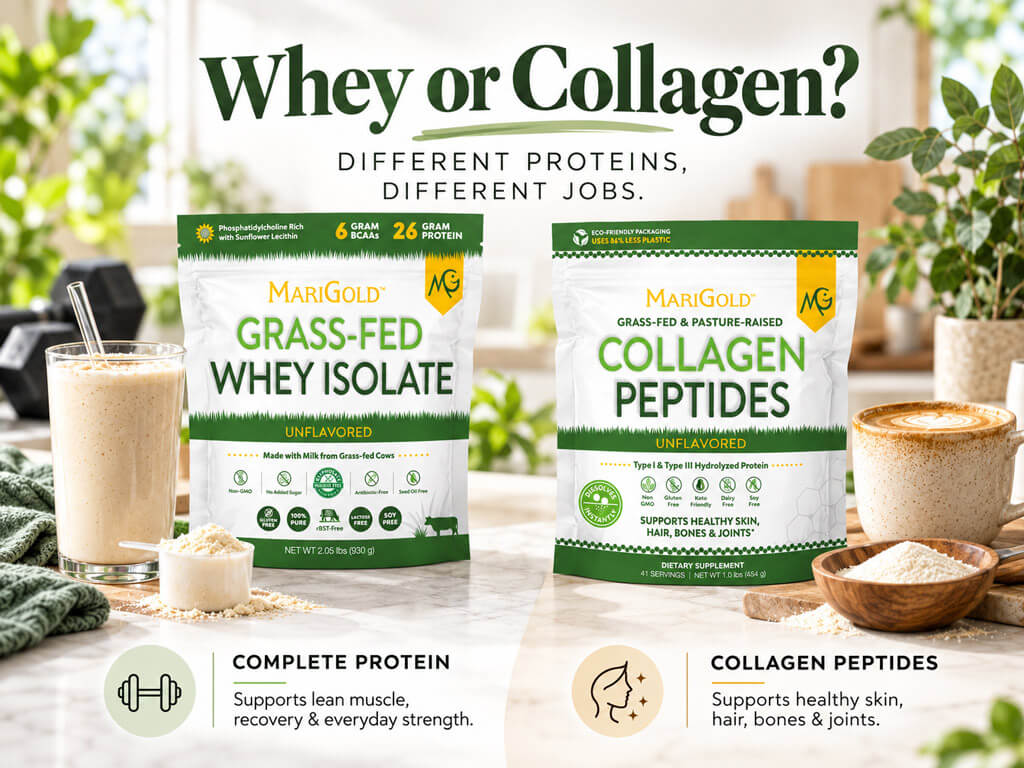
Protein isn’t one-size-fits-all. Whey isolate is a strong choice when you want a complete protein rich in essential amino acids, while collagen peptides offer a different amino acid profile that can complement a well-rounded protein routine.
The important part isn’t chasing one “perfect” protein—it’s choosing the right tool for what you want to support.








Love these articles…..most of all appreciate the easy to understand aspect!
Also…..love your products never have to worry about what’s in them. Miss your almond moca crunch bars…