The Protein Leverage Effect Most People Don’t Realize
For years, nutrition advice has focused on cutting things out – fewer carbs, less fat, fewer calories. But a growing body of research suggests the more powerful lever might actually be adding something back in: protein.
Not just for athletes or bodybuilders. For nearly everyone.
Scientists studying appetite regulation have uncovered something called the Protein Leverage Hypothesis, a theory that helps explain why many people struggle with constant hunger, overeating, and energy crashes – even when they’re trying to eat “healthy.”
The idea is surprisingly simple: your body prioritizes protein.
And if your diet doesn’t provide enough of it, your brain may push you to keep eating until it gets what it needs.
This means the issue for many people isn’t lack of discipline. It’s biology.
So what happens if you intentionally increase your protein intake for 30 days? Let’s take a closer look at what researchers have found – and what many people notice when they try it themselves.
The Protein Leverage Hypothesis: Why Low-Protein Diets Drive Overeating
The Protein Leverage Hypothesis, first proposed by nutritional scientists Stephen Simpson and David Raubenheimer, suggests humans have a strong biological drive to reach a target amount of protein each day.
When protein intake is diluted by large amounts of carbohydrates and fats – which often happens in ultra-processed foods – our bodies may compensate by encouraging us to eat more total calories.
In simple terms:
Low protein → increased hunger → more food consumed.
Several population studies support this idea. Diets that are lower in protein (10–12% of calories) are often associated with higher overall calorie intake, while diets with moderate protein levels (20–30%) tend to naturally regulate appetite.
This helps explain something many people have experienced:
You eat a large bowl of pasta or cereal… and feel hungry again an hour later.
But a meal with eggs, yogurt, fish, or a protein shake tends to keep you satisfied much longer.
Protein doesn’t just fill you up physically. It interacts with hormones that regulate hunger and satiety.
Protein’s Powerful Effect on Hunger Hormones
Protein influences several key hormones involved in appetite control:
GLP-1 – promotes satiety and slows stomach emptying
Peptide YY (PYY) – signals fullness to the brain
Ghrelin – the primary hunger hormone
Higher protein intake tends to:
- Increase GLP-1
- Increase PYY
- Reduce ghrelin
This combination helps the brain receive clearer signals that you’ve eaten enough.
In contrast, highly processed carbohydrate-heavy meals can trigger a rapid spike and drop in blood sugar, which may stimulate hunger again soon after eating.
Protein acts as a stabilizer in this system.
What Happens When You Increase Protein for 30 Days
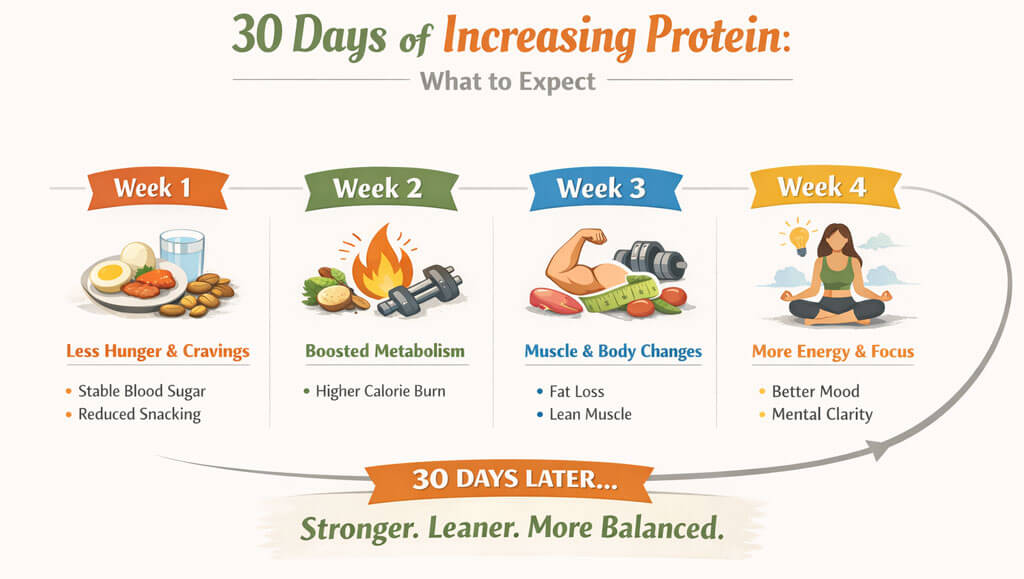
When someone intentionally increases protein intake – especially from high-quality sources – several physiological changes can occur.
Some happen quickly. Others develop over several weeks.
Here’s what many people experience.
Week 1: More Stable Hunger and Fewer Cravings
One of the first noticeable changes is improved satiety.
Because protein slows digestion and stimulates fullness hormones, meals tend to keep you satisfied longer. Many people find they naturally snack less or feel less urgency around food.
Blood sugar swings may also improve.
Pairing protein with carbohydrates slows glucose absorption, which can help reduce the classic mid-morning or mid-afternoon crash.
You may also notice:
- fewer sugar cravings
- less grazing between meals
- more consistent energy
Week 2: Metabolic Support and Thermogenesis
Protein has a unique metabolic advantage called the thermic effect of food (TEF).
Digesting protein requires significantly more energy than digesting carbohydrates or fats.
Approximate thermic effect:
- Protein: 20–30% of calories burned during digestion
- Carbohydrates: 5–10%
- Fat: 0–3%
In other words, protein slightly increases the number of calories your body burns simply by digesting it.
Over time, this can contribute to improved metabolic efficiency.
Week 3: Muscle Maintenance and Body Composition Changes
Protein provides the amino acids needed for muscle repair and maintenance.
Even without intense training, adequate protein helps preserve lean tissue, especially during weight loss.
This matters because muscle plays an important role in metabolic health.
More lean mass generally supports:
- better insulin sensitivity
- improved metabolic rate
- stronger physical function
For people who exercise regularly, adequate protein also helps support recovery and muscle protein synthesis.
Week 4: Energy, Cognitive Clarity, and Nutrient Balance
By the fourth week, many people notice broader improvements in how they feel overall.
Stable blood sugar and consistent nutrient intake often translate into:
- more stable energy throughout the day
- improved mental clarity
- better workout recovery
- fewer extreme hunger cycles
Protein-rich foods also tend to bring along other important nutrients such as iron, zinc, B vitamins, and essential amino acids.
How Much Protein Is “Enough”?
The traditional Recommended Dietary Allowance (RDA) for protein is 0.8 grams per kilogram of body weight per day.
However, many researchers now believe this level is the minimum needed to prevent deficiency, not necessarily the optimal intake for metabolic health.
Modern nutrition research often recommends:
1.2 – 1.6 g/kg per day for most adults
For someone weighing 150 pounds, that may mean roughly 80–110 grams of protein per day.
Athletes, older adults, or individuals trying to improve body composition may benefit from slightly higher levels.
Quality Matters: Not All Protein Is Equal
Protein quality also plays an important role.
Complete proteins provide all nine essential amino acids the body cannot produce on its own.
High-quality sources include:
- eggs
- dairy proteins
- fish
- meat
- collagen peptides (for connective tissue support)
- whey protein isolate
Whey protein, in particular, contains a high level of leucine, an amino acid that strongly stimulates muscle protein synthesis.
Collagen peptides provide glycine, proline, and hydroxyproline – amino acids that support skin, joints, and connective tissue health.
Both serve different but complementary roles in the body.
A Practical Way to Try the 30-Day Protein Experiment
Instead of drastically overhauling your diet, many people find success by simply adding protein strategically throughout the day.
For example:
Morning
Protein coffee or a protein-rich breakfast
Midday
A balanced meal containing 30–40 grams of protein
Afternoon
A protein-focused snack instead of refined carbohydrates
Evening
A whole-food meal with a quality protein source
Spreading protein intake across meals tends to support better absorption and more stable appetite signals.
The Bigger Picture
The Protein Leverage Hypothesis highlights something important about human biology:
Our bodies aren’t just counting calories.
They’re looking for nutrients.
When protein intake is too low, the body may push us to keep eating until those needs are met. But when protein intake is sufficient, appetite signals often become clearer and more balanced.
For many people, simply increasing protein intake – even without strict dieting – can lead to noticeable improvements in hunger control, energy, and overall metabolic health.
Sometimes the most effective nutrition strategy isn’t about restriction.
It’s about giving your body what it was asking for all along.
Fuel Your 30-Day Protein Experiment the Clean Way

If you’re curious what increasing your protein intake could do for your energy, appetite, and metabolism, the next step is simple: start adding high-quality protein sources to your daily routine.
At MariGold, we focus on clean, functional protein designed to support real nutritional goals.
Our Grass-fed Whey Isolate provides a highly bioavailable source of complete protein rich in essential amino acids like leucine, which helps support muscle maintenance and metabolic health.
Our Grass-fed Collagen Peptides supply glycine, proline, and hydroxyproline—amino acids that support connective tissue, skin, and gut health.
Both are formulated without artificial dyes, unnecessary fillers, or hidden additives. Just clean protein you can easily add to smoothies, coffee, baking, or simple daily meals.
You can also find both our collagen peptides and whey isolate in our Protein Coffee (and easy protein boost to start your day), Protein Bars, and Keto Fat Bombs (for quick, on-the-go protein fueled snacks)!
Because when you’re building better nutrition habits, ingredient quality matters just as much as quantity.