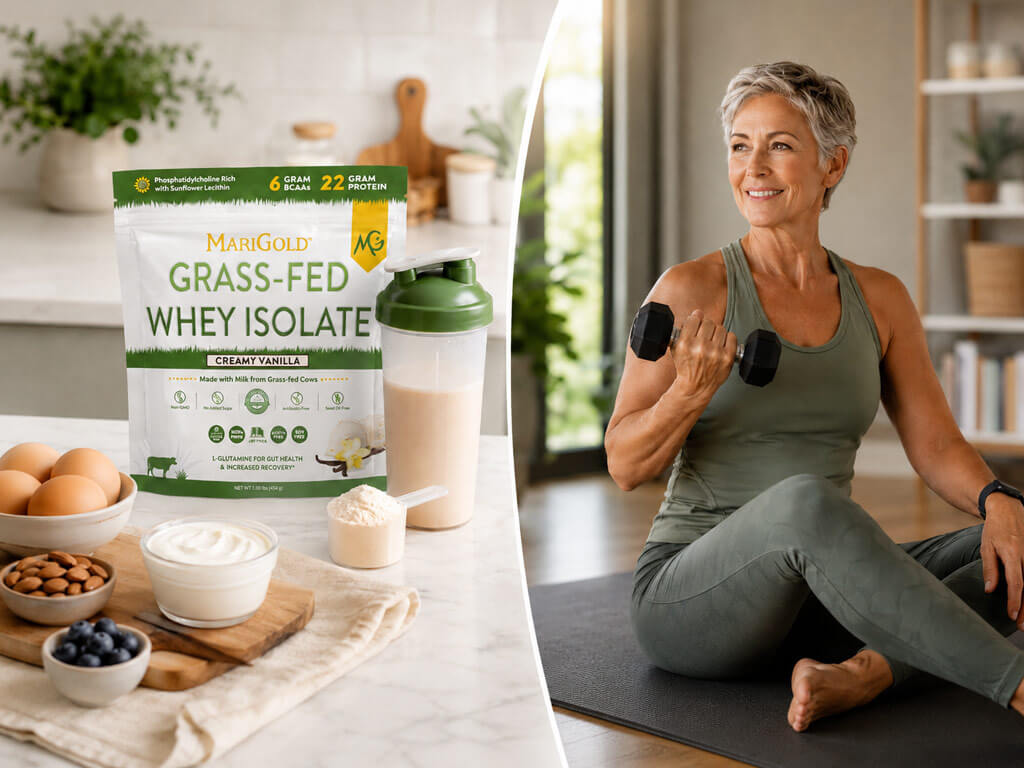
Protein is everywhere right now.
Protein coffee. Protein cereal. Protein snacks. High-protein yogurt. Protein-packed versions of foods that never used to be particularly high in protein.
And for good reason: protein is essential for maintaining muscle, repairing tissue, producing enzymes and hormones, supporting immune function, and helping us remain strong and functional as we age.
So when headlines recently began suggesting that eating less protein could actually promote healthy aging and longevity, it sounded almost completely backwards.
Aren’t we supposed to be eating more protein?
The answer is more complicated than either headline would have you believe.
A newly published scientific review examining protein, individual amino acids, and aging suggests that continually maximizing protein intake may not necessarily be beneficial for longevity. But it definitely does not mean protein is unhealthy—or that everyone should start cutting it from their diet.
The more interesting question is:
Can you eat too much protein for what your body actually needs?
And increasingly, researchers think the answer may depend on much more than simply how many grams of protein you eat.
Can You Actually Eat Too Much Protein?
Yes—but “too much” isn’t one universal number.
Protein needs vary substantially depending on age, body size, physical activity, calorie intake, health status, and whether you’re trying to build or preserve muscle.
There’s also an important difference between consuming more protein than your body needs and consuming an amount that’s outright harmful.
For a healthy person, eating somewhat above the minimum protein requirement does not suddenly make protein dangerous. Higher-protein diets can be particularly useful for people who exercise, are trying to preserve lean mass, or struggle to meet their protein requirements through food alone.
But more isn’t infinitely better.
A large meta-analysis examining protein supplementation with resistance training found that additional protein supported improvements in muscle mass and strength, but gains in fat-free mass tended to plateau once total protein intake reached approximately 1.6 grams per kilogram of body weight per day for the average participant. View the research.
That doesn’t mean 1.6 g/kg is a hard safety limit. Some athletes may appropriately consume more, and sports nutrition recommendations often place active adults somewhere around 1.4–2.0 g/kg per day depending on their goals. View the research.
It does illustrate something important:
Once your body has enough protein to accomplish a particular job, adding more doesn’t necessarily create proportionally greater benefits.
And new longevity research raises another question: could continually maintaining very high availability of certain amino acids affect biological pathways involved in aging?
What Does the New Longevity Research Actually Say?
A 2026 scientific review called The Hallmarks of Protein and Amino Acid Restriction in Aging evaluated hundreds of studies examining protein restriction, individual amino acids, metabolism, healthspan, and longevity.
Across numerous experimental models, reducing dietary protein has been associated with metabolic improvements and, in some organisms, longer lifespan.
But researchers are now realizing that total protein may not be the whole story.
Some of the benefits of protein restriction appear to be reproduced by reducing specific amino acids—particularly:
- methionine
- isoleucine
- valine
Isoleucine and valine are branched-chain amino acids, better known as BCAAs. All three are essential amino acids, meaning humans must obtain them through food. View the review.
So this research isn’t suggesting that these amino acids are “bad.”
You need them.
The scientific question is whether having large amounts continually available affects nutrient-sensing systems involved in aging and metabolism.
That distinction makes the story a lot less dramatic than:
“Eating protein makes you age faster.”
That’s not what the research shows.
Why Would Eating Less Protein Ever Help With Longevity?

This starts to make more sense once you stop thinking of amino acids only as construction materials.
Amino acids don’t simply become muscle, enzymes, skin, or other proteins. They also act as signals.
When plenty of nutrients and amino acids are available, the body receives signals that resources are plentiful.
One important pathway involved is mTORC1, or mechanistic target of rapamycin complex 1.
If you follow strength-training research, you’ve probably heard about mTOR before.
Resistance exercise and essential amino acids—particularly leucine—help activate mTOR signaling and stimulate muscle protein synthesis.
That’s exactly what we want after training.
But longevity research has repeatedly linked reduced nutrient and growth signaling with cellular processes associated with stress resistance and maintenance.
The new review describes protein and amino-acid restriction as affecting mTORC1 along with other nutrient-sensing and metabolic pathways including GCN2, ATF4, and FGF21.
In very simplified terms, your body’s biology needs to balance two different priorities:
BUILD AND GROW and MAINTAIN, ADAPT, AND REPAIR
Neither state is inherently better.
You wouldn’t want your body permanently stuck in either one.
And that’s where the protein-and-longevity conversation gets much more interesting.
Is Protein Bad for Longevity?
Based on the evidence we have today: no. That would be far too simplistic.
Much of the evidence showing lifespan extension from protein or amino-acid restriction comes from animal models and other experimental organisms.
For example, restricting isoleucine in genetically diverse mice improved metabolic health, reduced frailty, and increased lifespan.
That’s scientifically fascinating. But mice aren’t humans.
We do not currently have long-term randomized trials demonstrating that healthy humans who deliberately restrict protein or BCAAs live longer.
Even coverage of the new review emphasizes that its findings concern specific amino acids and experimental aging pathways—not a blanket recommendation for humans to simply eat less protein. Read the Medical News Today coverage.
So it’s much too early to turn this into a dietary rule.
The Protein Paradox of Healthy Aging
Here’s where things get especially interesting.
At the cellular level, lowering certain nutrient signals may potentially support pathways associated with longevity.
At the whole-body level, however, losing muscle as we age is something we very much want to prevent.
Older adults experience something called anabolic resistance, meaning aging muscle becomes less responsive to the muscle-building effects of protein.
That can contribute to gradual loss of skeletal muscle mass and strength. View the research.
Muscle isn’t only about looking strong.
Maintaining it helps support:
- strength
- mobility
- balance
- metabolic health
- independence
- the ability to recover from illness or inactivity
So aggressively restricting protein in the name of longevity could potentially work against another major goal of healthy aging: remaining physically capable.
That gives us an apparent contradiction:
Less growth signaling may sometimes be associated with longevity.
But:
Adequate protein and muscle stimulation are extremely important for maintaining strength as we get older.
Both can be true.
Healthy aging isn’t simply about maximizing one molecular pathway.
Exercise Changes the Protein Conversation
This may be one of the biggest pieces missing from simplified discussions about “too much protein.”
Someone who resistance trains several times a week is doing something very different with dietary amino acids than someone who is sedentary.
Exercise creates demand. Muscle tissue has been stressed and needs amino acids for remodeling and repair.
Resistance exercise and protein ingestion also work synergistically to stimulate muscle protein synthesis. View the research.
So imagine two people eating the same amount of protein:
- One regularly strength trains.
- The other gets very little physical activity and is already consuming plenty of calories and protein.
Their nutritional needs aren’t necessarily identical just because the number on a protein tracker is the same.
This is why “How much protein should I eat?” isn’t really a complete question.
A better question is:
How much protein does my body need for what I’m asking it to do?
So How Much Protein Is Too Much?
This is probably what most people want to know.
Unfortunately, there isn’t one number at which healthy protein intake suddenly becomes “too much.”
The basic Recommended Dietary Allowance for adults is designed to prevent inadequacy, not necessarily to optimize muscle retention, athletic performance, or healthy aging.
Meanwhile, physically active people commonly benefit from higher protein intakes, with sports nutrition guidance generally placing many exercising adults around 1.4–2.0 g/kg/day. View the research.
Research on resistance training suggests that muscle-building benefits tend to show diminishing returns around an average intake of roughly 1.6 g/kg/day, although individual needs vary. View the research.
For perspective, a 150-pound person weighs about 68 kilograms. At 1.6 g/kg, that’s roughly 109 grams of protein per day.
That isn’t a target everyone needs to hit.
It also isn’t an upper safety limit.
It’s simply an example of why endlessly increasing protein doesn’t necessarily mean endlessly increasing muscle or health benefits.
The practical takeaway is less exciting than a viral headline: Enough matters. More may help in the right circumstances. More and more isn’t automatically better.
Not All Protein Is the Same
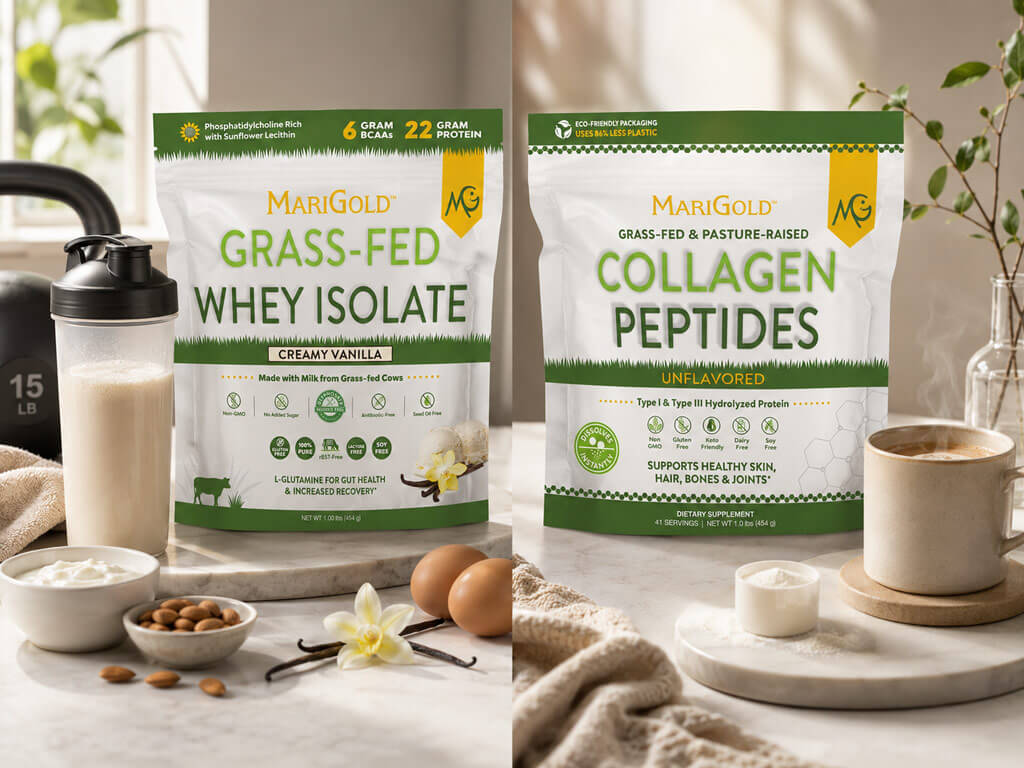
There’s another reason total grams don’t tell the whole story.
Protein isn’t one single substance. Every dietary protein contains its own combination of amino acids, and those differences affect how the body uses it.
Take two proteins we use frequently at MariGold: whey isolate and collagen peptides.
Both contribute protein. But they’re nutritionally very different.
Whey Isolate: Complete Protein for Muscle and Recovery
Whey protein provides all nine essential amino acids and is naturally rich in branched-chain amino acids, including leucine, isoleucine, and valine.
That’s part of what makes whey so effective when your goal is stimulating muscle protein synthesis.
Research in older adults, for example, has found whey much more effective than collagen peptides for stimulating muscle protein synthesis. View the research.
That’s not surprising.
They’re different proteins designed—nutritionally speaking—for different jobs.
A high-quality whey isolate makes particular sense when you’re:
- strength training
- recovering after exercise
- trying to maintain or build lean mass
- supplementing a diet that’s short on complete protein
- dealing with higher protein requirements
Interestingly, some of the same amino acids that make whey so useful for muscle—particularly BCAAs—are among those being investigated in amino-acid restriction and longevity research.
That does not make whey unhealthy. It simply demonstrates why context matters.
If your muscles need those amino acids for repair and adaptation after exercise, they have a job to do.
Collagen Peptides Have a Very Different Amino-Acid Profile
Collagen looks dramatically different on an amino-acid chart.
Collagen is especially rich in: glycine, proline, and hydroxyproline.
These amino acids are characteristic components of collagen-rich connective tissues throughout the body.
Collagen also isn’t a complete protein in the same way whey is, which is one reason it isn’t nutritionally interchangeable with whey when the goal is maximizing muscle protein synthesis.
Again, that’s not a flaw. It’s a different protein with a different amino-acid profile.
And this new research is a useful reminder that 20 grams of one protein and 20 grams of another aren’t necessarily giving your body identical nutritional information.
That’s something protein gram counts alone can’t tell you.
Does That Mean Collagen Is Better for Longevity?
No—and this distinction is important.
We don’t currently have evidence showing that switching from whey to collagen extends human lifespan.
We also shouldn’t interpret collagen’s lower BCAA content or unique amino-acid profile as proof that collagen is a “longevity protein.”
That’s several scientific steps beyond what the research actually demonstrates.
What this research does reinforce is something nutrition science has known for a long time: Protein quality and amino-acid composition matter.
And longevity research is now giving scientists additional reasons to study those differences.
What About Eating Tons of Protein Just Because It’s Popular?
This may ultimately be the most practical lesson from the new research.
Protein has become shorthand for “healthy.”
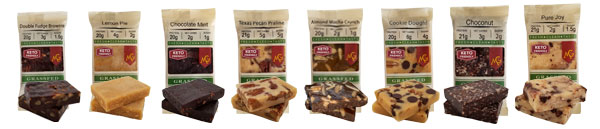
And that’s created an unusual nutrition trend where people may feel that if 25 grams is good, 40 must be better—and 60 must be even better.
- Protein gets added to breakfast.
- Then coffee.
- Then a shake.
- Then a protein snack.
- Then lunch.
- Then another bar.
- Then a high-protein dinner.
Depending on the person, that might make perfect sense. Or it might simply be adding protein because high protein has become the goal itself.
Those aren’t the same thing.
When you’re choosing a protein source, it’s worth asking: What am I trying to accomplish with it?
- Am I trying to recover after strength training?
- Preserve muscle as I get older?
- Fill a genuine gap in my diet?
- Add collagen-specific amino acids?
- Stay fuller between meals?
Or am I trying to hit the largest protein number possible because I’ve been told more is better?
That last assumption is exactly what longevity researchers are beginning to question.
Protein With Purpose
At MariGold, we work with both grass-fed whey isolate and grass-fed collagen peptides precisely because protein isn’t one-size-fits-all.
Our Grass-Fed Whey Isolate provides complete protein and essential amino acids, making it particularly valuable when the goal is supporting protein intake, muscle maintenance, an active lifestyle, and recovery.
Our Grass-Fed Type I & III Collagen Peptides provide a distinctly different amino-acid profile rich in the characteristic amino acids found in collagen.
One isn’t universally “better” than the other.
They’re useful for different reasons.
And perhaps that’s where the broader protein conversation needs to go next.
Instead of: How can I eat more protein?
Try: What kind of protein makes sense for me—and what do I need it to do?
The Bottom Line: Should You Worry About Eating Too Much Protein?
For most healthy people, this new research isn’t a reason to panic about your protein shake.
It isn’t a reason to stop eating whey.
And it certainly isn’t a reason for older adults or physically active people to begin dramatically restricting protein without considering their muscle and nutritional needs.
But it is a reminder that nutrition rarely follows a “more is always better” rule.
Protein is essential. Adequate protein becomes particularly important when you’re physically active or trying to maintain muscle as you age.
But once your body has enough protein for its needs, simply continuing to increase the amount may not create additional benefit—and scientists are now studying whether chronic exposure to high levels of particular amino acids has consequences for metabolism and aging.
We don’t have all of those answers yet.
For now, the emerging science points toward a much smarter philosophy:
Get enough protein. Match it to your needs. Choose the type intentionally. And don’t assume that the biggest number is automatically the healthiest choice.
That’s protein with purpose.
Protein With Purpose
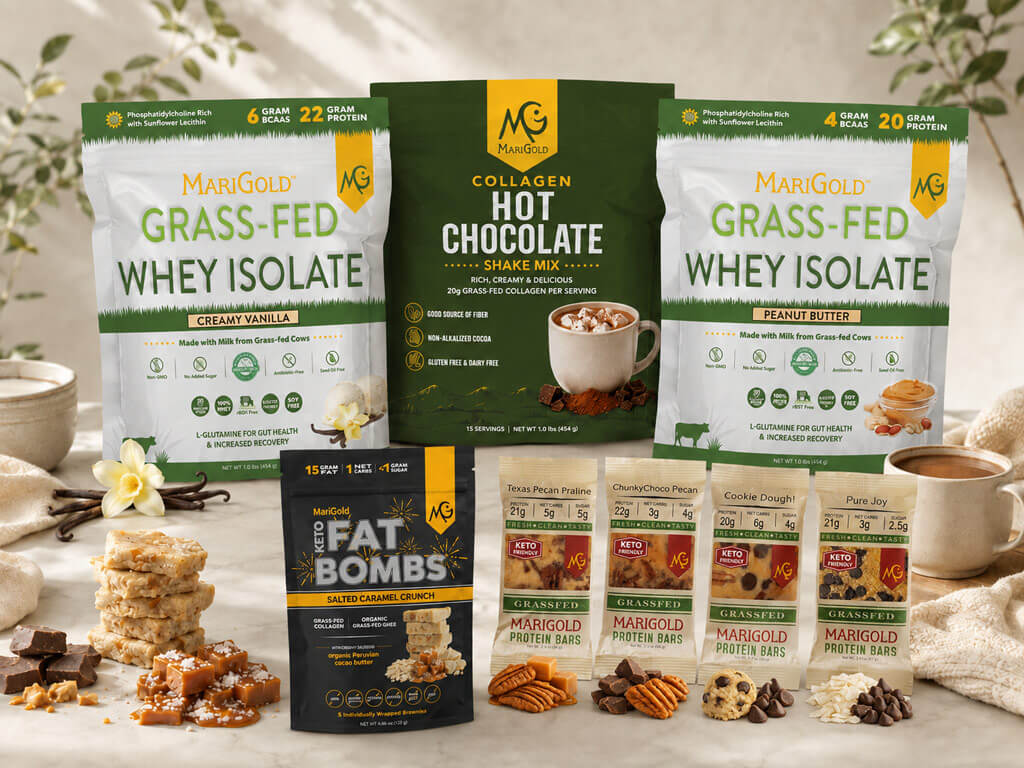
Protein isn’t one-size-fits-all. Whether you’re supporting muscle and recovery with whey isolate or adding collagen-specific amino acids to your routine, the goal isn’t simply more protein—it’s choosing the right protein for what your body needs.