“Grass-fed” has become one of those phrases we instinctively associate with higher-quality food. We look for it on butter, beef, milk—and increasingly, protein powder.
But when you’re buying whey protein, does grass-fed actually matter?
Yes, but probably not for all the reasons you’ve heard.
What a cow eats can influence the composition of the milk it produces. Research has found meaningful differences between milk produced under pasture- and forage-based feeding systems and milk from more conventional feeding systems, particularly in the fatty-acid profile.
But protein powder isn’t whole milk. By the time whey has been separated, filtered and—in the case of whey isolate—further refined into a highly purified source of protein, we’re dealing with a very different food.
That’s why grass-fed is a good place to start. It just shouldn’t be where you stop.
To understand what makes a whey protein worth choosing, we need to look at where it comes from, what type of whey it contains, how it’s processed, and what else ends up in the finished product.
What Does Grass-Fed Whey Protein Actually Mean?
Whey begins with milk.
During cheesemaking, milk separates into solid curds and liquid whey. That liquid contains whey proteins, along with varying amounts of lactose, fat, minerals and other components. Manufacturers can then filter and process the whey into ingredients such as whey protein concentrate and whey protein isolate.
When a protein powder is described as grass-fed, the claim refers to the feeding practices associated with the cows producing that original milk.
It doesn’t describe a different type of protein.
And the exact feeding protocols behind grass-fed claims can vary among producers, which is why the term alone doesn’t tell you everything about how a particular whey was produced.
What it does tell you is something about where your protein started.
And that matters—but there’s much more to the story.
Does Grass-Fed Milk Have Nutritional Advantages?
This is where there is some interesting research.
A cow’s diet can influence the composition of its milk. Studies of pasture- and forage-based feeding have found differences in milk fatty acids, including higher concentrations of certain omega-3 fatty acids and conjugated linoleic acid (CLA) under some grass- and pasture-based feeding systems.
That’s one reason grass-fed dairy has attracted so much attention.
But here’s the detail that gets lost when those findings are applied to protein powder:
Many of those nutritional differences are found in the milk fat.
That’s very relevant if you’re comparing grass-fed and conventional whole milk or butter.
It’s considerably less relevant when you’re talking about a product specifically designed to remove most of the fat.
And that’s exactly what whey protein isolate does.
So Why Choose Grass-Fed Whey Isolate?
Because you’re making two separate choices:
- Grass-fed describes where the protein starts.
- Isolate describes how the whey is filtered to give you a higher proportion of protein.
If you’re buying protein powder, presumably one of your primary goals is to get—you guessed it—protein.
Whey protein isolate undergoes additional filtration that removes much of the lactose, fat and carbohydrate while concentrating the whey protein. Whey isolates are generally around 90% or more protein by dry weight, whereas whey concentrates can vary much more widely in their protein concentration.
So choosing grass-fed whey isolate isn’t necessarily about trying to preserve every component found in grass-fed whole milk.
It’s about starting with a dairy source you’ve deliberately chosen, then using additional filtration to give you more of what you’re actually looking for: high-quality whey protein.
That’s an important difference.
But Wouldn’t Grass-Fed Whey Concentrate Give Me More Omega-3s and CLA?
Potentially, a whey concentrate can retain more milk fat and other non-protein components than a whey isolate.
And because compounds such as omega-3 fatty acids and CLA are associated with the fat fraction of dairy, it makes sense to wonder whether grass-fed whey concentrate might preserve more of those components.
But that raises a more practical question:
Are you buying protein powder for its fat—or for its protein?
Whey concentrate isn’t generally considered a significant dietary source of omega-3 fatty acids. Its fat content varies depending on the degree of concentration and the individual product.
If increasing omega-3 intake is your goal, foods that naturally provide meaningful amounts of omega-3s – such as salmon or chia seeds – make considerably more sense than choosing a less-purified protein powder in hopes of retaining a small amount of milk fat.
Your protein powder doesn’t have to do every nutritional job.
If you’re choosing whey specifically as a protein supplement, there’s a strong argument for prioritizing the thing whey isolate does exceptionally well: providing highly digestible, complete protein rich in essential amino acids.
Whey Isolate vs. Whey Concentrate: What’s the Difference?
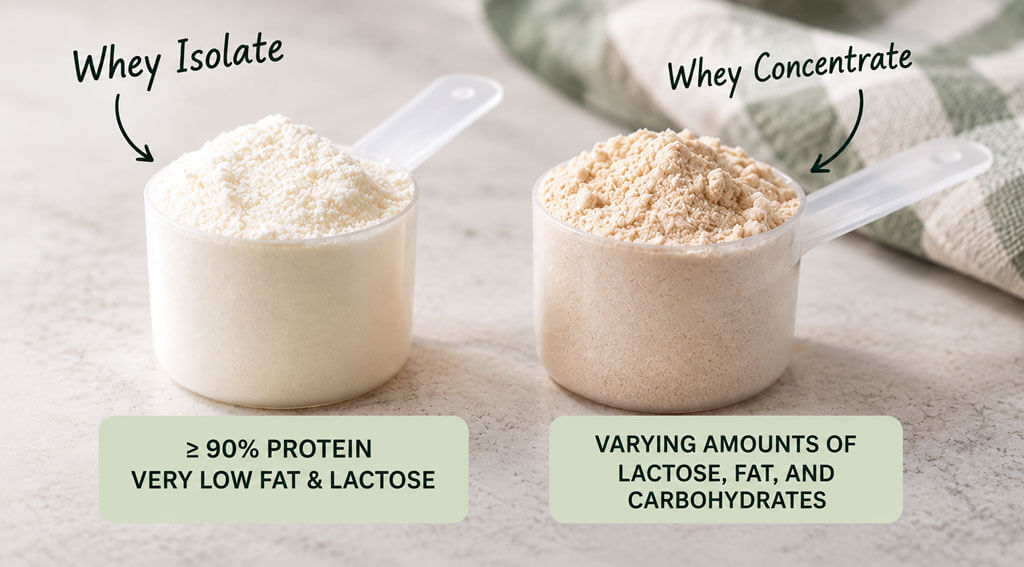
Both begin with whey, but the finished ingredients can be quite different.
Whey protein concentrate undergoes filtration but retains varying amounts of lactose, fat, carbohydrates, minerals and other milk components. Depending on the degree of concentration, its protein content can vary substantially.
Whey protein isolate undergoes additional filtration to remove more of those non-protein components. The result is generally at least 90% protein by dry weight with very little fat and lactose.
That can make isolate particularly appealing if your goal is to:
- Get more protein with fewer accompanying carbohydrates and fats
- Minimize lactose (easier digestion for those sensitive to lactose)
- Increase protein without substantially increasing calories from other macronutrients
- Add protein easily to foods, smoothies or coffee
- Know that most of what you’re scooping is actually protein
Whey concentrate isn’t inherently an inferior food. It simply isn’t as concentrated a source of protein.
If you’re buying a protein supplement, that’s a meaningful distinction.
Does Grass-Fed Whey Build More Muscle?
There’s no convincing evidence that grass-fed whey inherently builds more muscle than an equivalent amount of otherwise comparable conventional whey.
The muscle-supporting benefits come primarily from whey itself.
Whey is considered a high-quality protein because it’s highly digestible and provides all nine essential amino acids. It’s also naturally rich in branched-chain amino acids, particularly leucine, which plays an important role in stimulating muscle protein synthesis.
Research supports whey protein as an effective way to stimulate muscle protein synthesis, particularly in combination with resistance exercise.
So if you’re comparing protein powders for muscle support, the better question isn’t simply: Is it grass-fed?
It’s better to ask:
- How much protein does it provide?
- What kind of whey is it?
- What else is in the scoop?
Those answers tell you considerably more about the product you’re actually consuming.
Is Grass-Fed Whey Better If You’re Sensitive to Lactose?
Grass-fed isn’t the important distinction here. Isolate is.
Lactose is the naturally occurring carbohydrate in dairy milk. Cows don’t stop producing lactose because they’re eating grass.
Whey concentrate retains varying amounts of lactose, while the additional filtration used to make whey isolate removes substantially more of it.
That means someone trying to minimize lactose should pay much closer attention to “whey protein isolate” versus “whey protein concentrate” than to “grass-fed” alone.
This is a perfect example of why you can’t judge protein powder by one attractive phrase on the front of the package.
What Actually Makes a High-Quality Whey Protein?
Once you understand grass-fed as the starting point rather than the finish line, shopping for protein becomes much easier.
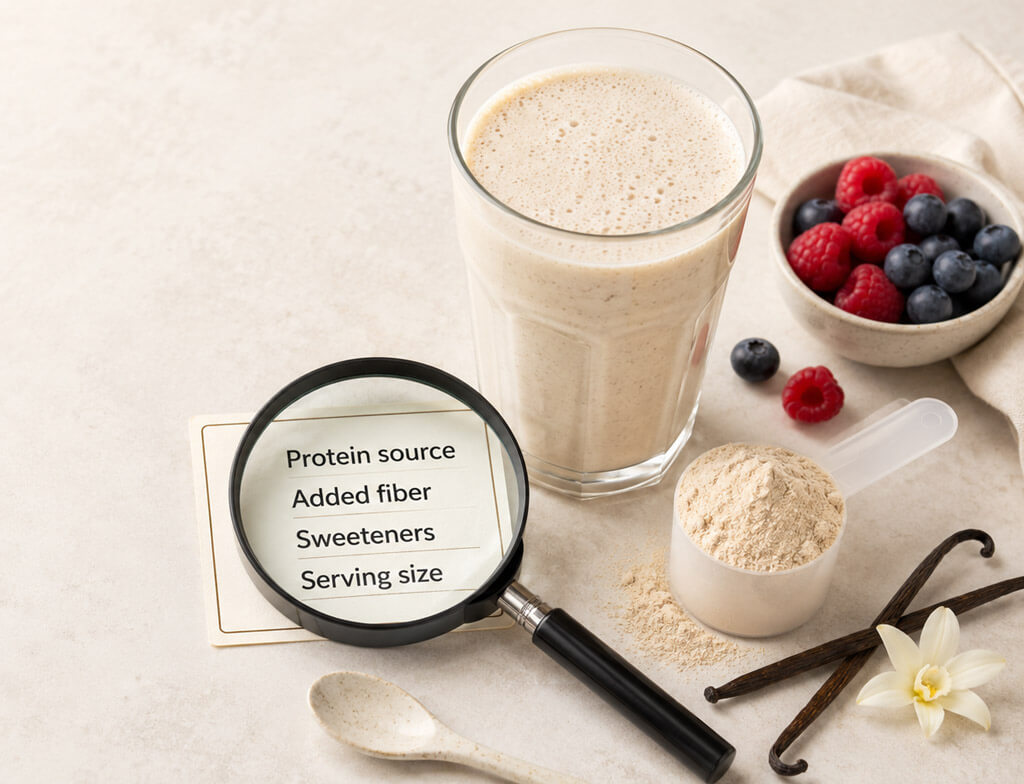
Here are the things worth considering.
1. Start with the source
If sourcing matters to you, grass-fed whey gives you additional information about the dairy behind your protein.
Cow diet can influence milk composition, and choosing grass-fed dairy may align with your preferences about how your food is produced.
But don’t stop reading the label there.
2. Check whether it’s isolate or concentrate
This tells you much more about the composition of the protein powder you’re actually going to consume.
If you’re looking for a highly concentrated protein with minimal lactose, fat and carbohydrate, whey isolate has a clear practical advantage.
3. Look at how it’s processed
Where protein starts matters.
What happens to it afterward matters, too.
Processing methods vary among manufacturers. If quality is important to you, look for companies that are transparent about how their whey is produced and filtered.
For example, cold processing and microfiltration can be used to produce whey isolate without relying on excessive heat while separating protein from other components of whey.
4. Compare actual protein per serving
A giant scoop doesn’t necessarily equal a lot of protein.
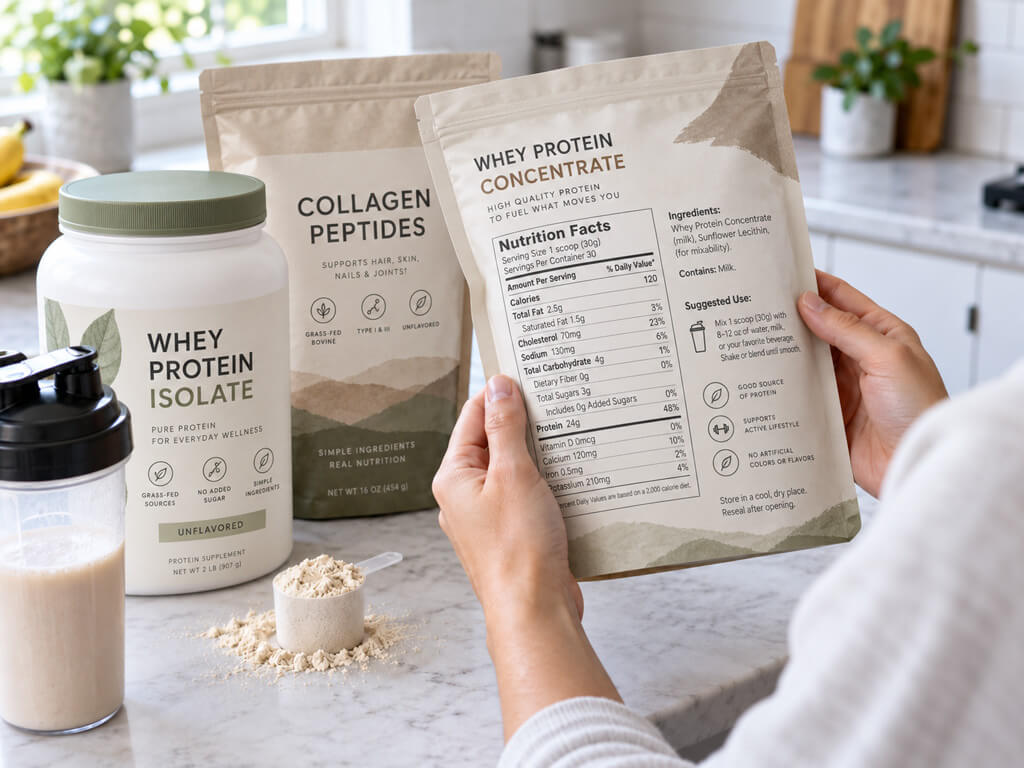
Check the nutrition panel and compare the grams of protein you’re receiving with the serving size.
When you’re buying a protein supplement, a high proportion of actual protein is a pretty reasonable thing to expect.
5. Turn the package around
A premium protein source can still end up in a formula filled with ingredients you don’t particularly want.
Look at sweeteners, flavors, gums, fillers and other additives rather than allowing one front-of-package claim to make the decision for you.
If avoiding artificial sweeteners or sugar alcohols matters to you, check for them specifically.
6. Look for specific verification—not vague promises
Words such as clean, premium and pure can sound impressive without telling you much.
Specific third-party certifications and testing tell you exactly what has—or hasn’t—been verified.
MariGold, for example, uses grass-fed whey isolate that is cold-processed and microfiltered. Our formulas don’t use artificial sweeteners or sugar alcohols, and our products carry Glyphosate Residue Free certification from The Detox Project.
None of those things individually defines the perfect protein powder.
Together, however, they tell you considerably more than the word grass-fed ever could.
So, Is Grass-Fed Whey Protein Better?

Grass-fed can be a meaningful sign of thoughtful sourcing—but it shouldn’t be the only reason you choose a whey protein.
Research tells us that what cows eat can affect the composition of their milk, particularly its fatty-acid profile. But many of the nutritional differences associated with grass-fed whole dairy occur in the fat—which whey isolate intentionally removes.
That doesn’t make grass-fed irrelevant.
It means we need to ask a better question: What happens to that dairy source next?
If your goal is protein, whey isolate gives you more of what you’re actually looking for while removing much of the lactose, fat and carbohydrate. Then processing methods, ingredient choices, sweeteners and third-party verification help determine the quality of the finished product.
So rather than looking for one magic phrase on a package, think of quality as a series of decisions:
- Where did it start?
- What type of protein is it?
- How was it processed?
- What was added to it?
- And can the company substantiate the claims it’s making?
Grass-fed can be a good place to start.
A truly high-quality whey protein gives you plenty of reasons to keep reading.
Now You Know What to Look For.
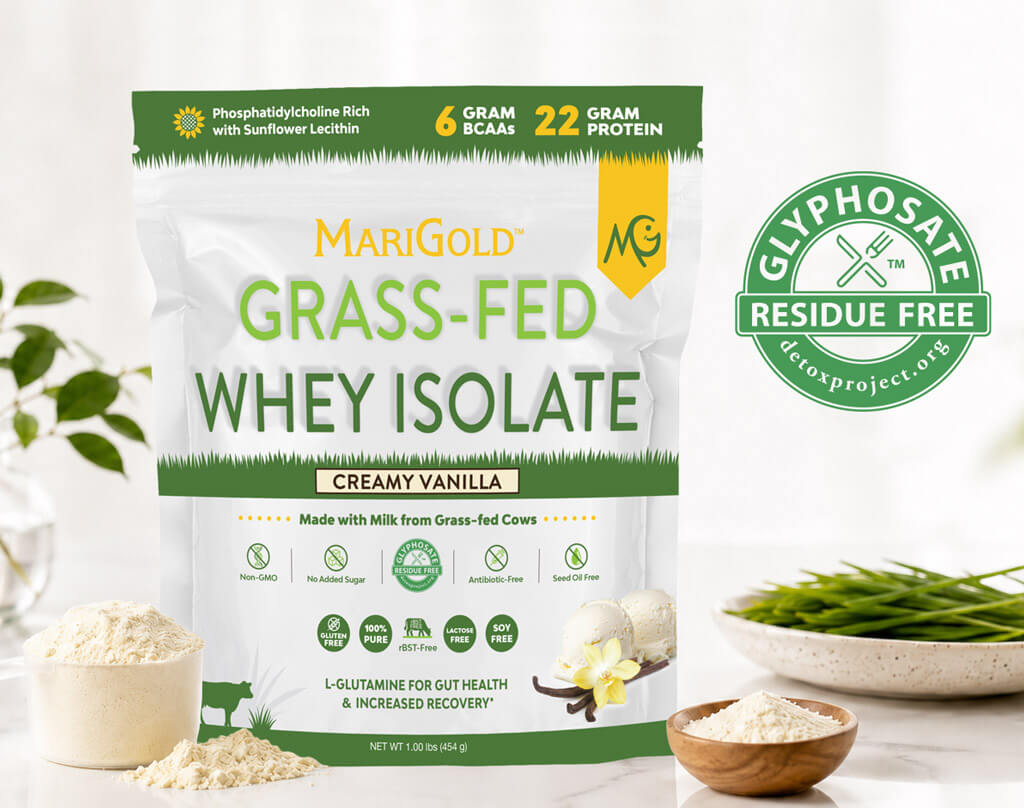
Grass-fed sourcing. Whey isolate. Thoughtful processing. A clean ingredient list. Meaningful third-party verification.
MariGold brings those choices together with cold-processed, microfiltered whey isolate that’s certified Glyphosate Residue Free by The Detox Project—giving you more of what you came for, and less of what you didn’t.