“Clean protein powder” sounds straightforward.
It isn’t.
There is no single regulated definition of what makes a protein powder “clean,” which means the term can mean very different things from one brand to another. For some companies, it may refer to a short ingredient list. For others, it might mean no artificial sweeteners, grass-fed dairy, organic ingredients, minimal processing, or simply a label designed to look wholesome.
So how do you actually choose a clean protein powder?
A better approach is to look beyond the front of the package and evaluate the things that really matter:
- The protein source
- How it is processed
- What else is in the formula
- How it is sweetened
- Where the ingredients come from
- Whether the brand backs up its claims with meaningful transparency or testing.
Here are eight things worth checking before your next scoop.
1. Start With the Protein Source
The first ingredient on a protein powder label should tell you where the protein is actually coming from.
Common options include:
- Whey protein isolate
- Whey protein concentrate
- Collagen peptides
- Casein
- Pea protein
- Rice protein
- Blended plant proteins
These protein sources are not interchangeable. They differ in amino acid profile, digestion, lactose content, texture, and how they function in the body.
Whey Protein
Whey is considered a complete protein because it contains all nine essential amino acids. It is also naturally rich in leucine, an amino acid that plays an important role in stimulating muscle protein synthesis.
That makes whey particularly useful for people looking to support muscle maintenance, recovery, and overall protein intake.
Collagen Protein
Collagen is different. Collagen peptides contain high amounts of amino acids such as glycine, proline, and hydroxyproline, but collagen does not have the same complete essential amino acid profile as whey.
That does not make collagen less useful. It simply means collagen and whey serve different nutritional purposes.
When choosing a clean protein powder, start by asking: What kind of protein am I actually buying, and does it fit what I want the product to do?
2. Look at How Much Protein You’re Actually Getting
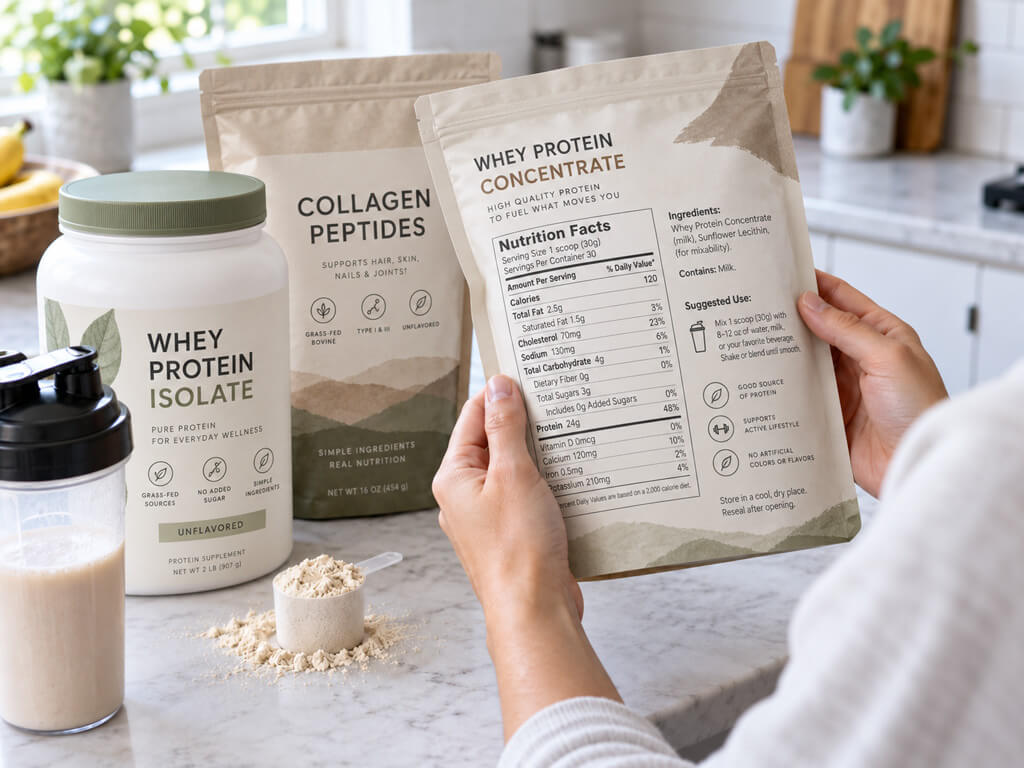
The front of a package may advertise “high protein,” but the nutrition panel tells you more.
One useful comparison is the amount of protein relative to the total serving size.
If a 30-gram scoop contains 25 or 26 grams of protein, most of that scoop is actually protein.
If a much larger serving provides substantially less protein, more of the formula is coming from additional ingredients such as carbohydrates, fats, fibers, flavoring ingredients, sweeteners, or other additions.
That is not automatically a bad thing.
A meal-replacement shake or a specialty protein blend may intentionally contain more ingredients.
But if you’re looking for a straightforward protein powder, protein density can give you a quick look at how concentrated the formula really is.
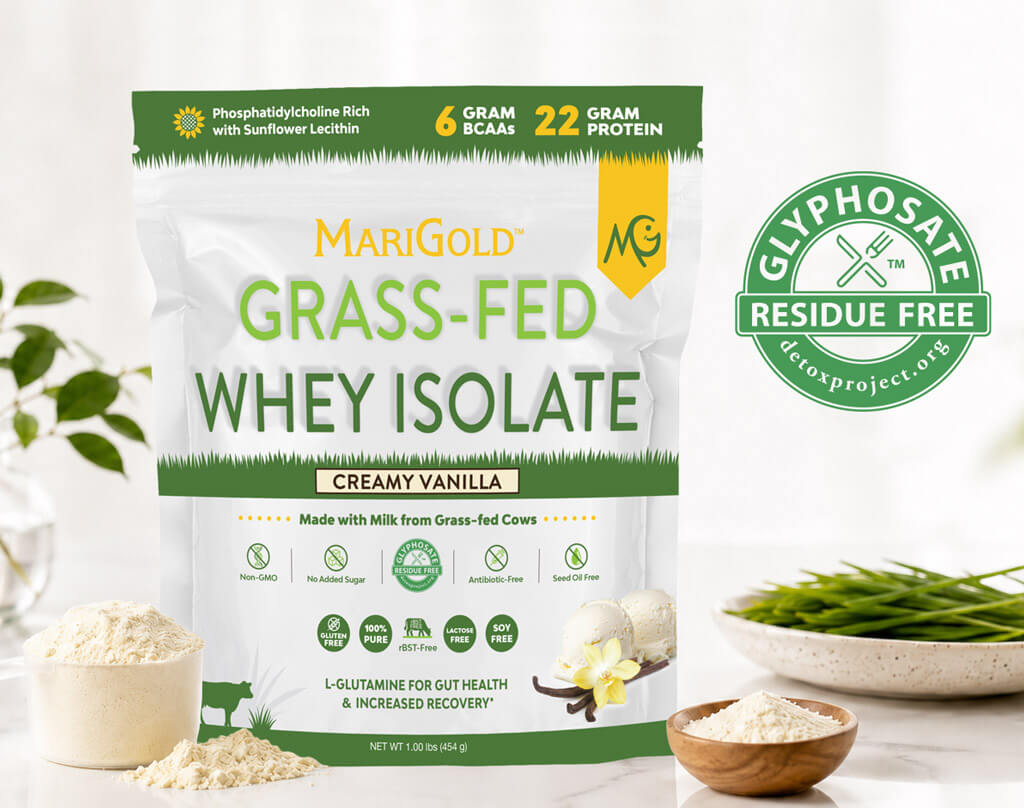
For example, MariGold Unflavored Grass-Fed Whey Isolate provides 26 grams of protein in a 30-gram serving, making protein the overwhelming majority of the scoop.
Sometimes the nutrition panel tells you more about a protein powder than any marketing claim on the front.
3. Know the Difference Between Whey Isolate and Whey Concentrate
If you’re shopping for whey protein, you’ll commonly see two forms:
Whey protein concentrate and whey protein isolate.
Both come from milk, but they are processed differently.
Whey concentrate retains more naturally occurring lactose, fat, and carbohydrate.
Whey isolate undergoes additional filtration, which removes more of those components and produces a protein that is typically:
- Higher in protein by weight
- Lower in lactose
- Lower in fat
- Lower in carbohydrates
That makes whey isolate particularly attractive for people who want a more concentrated source of protein or who are trying to minimize lactose.
MariGold uses cold-processed, micro-filtered grass-fed whey protein isolate rather than whey concentrate.
The additional filtration removes most of the lactose while maintaining a high percentage of protein per serving.
Does Whey Isolate Contain Lactose?
Whey isolate is derived from milk, but the filtration process removes the vast majority of its lactose.
That means some people who experience digestive discomfort with whey concentrate or other dairy products find whey isolate easier to tolerate.
However, lactose intolerance is different from a milk allergy.
Whey protein isolate still contains milk protein and is not appropriate for someone with a milk protein allergy.
4. Don’t Let the Word “Clean” Make the Decision for You
“Clean.”
“Natural.”
“Premium.”
“Pure.”
“Healthy.”
These words may sound reassuring, but they do not tell you much on their own.
There is no universal requirement that a clean protein powder must contain exactly three ingredients, five ingredients, or any other arbitrary number.
A short ingredient list can certainly make a product easier to evaluate, but ingredient quality and purpose matter more than simply counting how many ingredients appear on the label.
A flavored protein powder will naturally contain more ingredients than an unflavored one.
Chocolate may require cocoa. Vanilla needs flavoring. A powder designed to disperse easily in liquid may include a small amount of lecithin.
Instead of asking:
“Does this ingredient name sound complicated?”
Ask:
“Why is this ingredient here?”
That is a much more useful way to evaluate a formula.
A good ingredient list should make sense for the product you’re buying.
5. Pay Attention to How Your Protein Powder Is Sweetened
Sweeteners are one of the biggest differences between protein powders.
They can also have a major impact on flavor, carbohydrate content, and digestive tolerance.
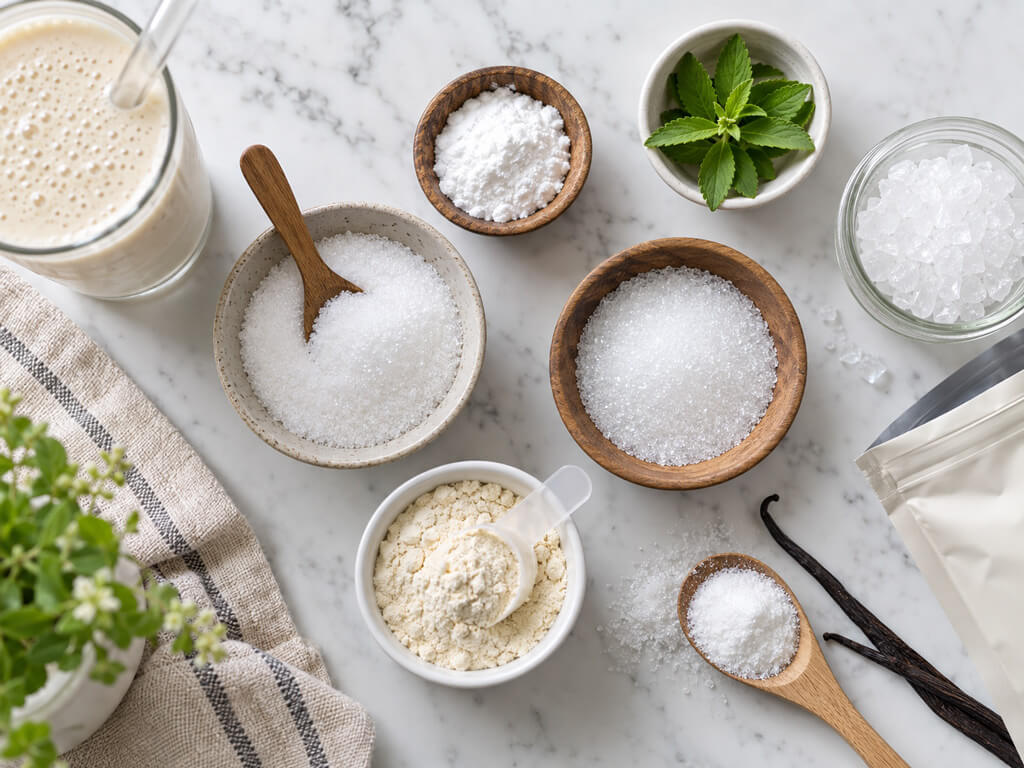
Common protein-powder sweeteners include:
- Added sugar
- Sucralose
- Acesulfame potassium
- Stevia
- Monk fruit
- Allulose
- Erythritol
- Maltitol
- Other sugar alcohols
There isn’t one sweetener that is right for everyone.
Some people prefer to avoid artificial sweeteners. Others don’t mind them at all.
Some people enjoy stevia. Others are sensitive to its flavor.
And certain sweeteners can affect digestion differently from person to person.
Sugar Alcohols and Digestion
Sugar alcohols are commonly used in low-sugar foods because they provide sweetness with fewer digestible carbohydrates than regular sugar. But they aren’t always well tolerated. Depending on the type and amount consumed, sugar alcohols can contribute to gas, bloating, cramping, or loose stools in some people.
More recently, researchers have also begun looking at their potential cardiovascular effects. Studies involving erythritol and xylitol have found associations between higher circulating levels and increased risk of cardiovascular events, along with experimental evidence suggesting these sweeteners may increase platelet activity and the tendency for blood clots to form. However, researchers have not yet established that consuming these sugar alcohols directly causes heart attacks or strokes, and more long-term research is needed.
For people who prefer to avoid sugar alcohols while that research continues—or simply because they don’t tolerate them well—checking the sweetener section of a protein powder label is worthwhile.
MariGold flavored whey isolate formulas do not use sugar alcohols or artificial sweeteners.
Instead, depending on the flavor, we use stevia and non-GMO allulose. Stevia is a plant-derived, high-intensity sweetener, so only a small amount is needed to provide sweetness. It contributes little to no calories and generally does not raise blood sugar levels.
Allulose is a little different—and often misunderstood. Despite ending in “-ose,” allulose is not the same as fructose, sucrose, or sucralose. It is a naturally occurring “rare sugar” found in small amounts in foods such as figs and raisins, but the body metabolizes it very differently from traditional sugar. The FDA allows allulose to be calculated at about 0.4 calories per gram, compared with 4 calories per gram for regular sugar, and it is not counted as Total Sugars or Added Sugars on Nutrition Facts labels under current FDA guidance.
Allulose also has very little impact on blood glucose compared with traditional sugar, making it useful for creating sweetness without the same sugar load. MariGold has a deeper look at the research and potential benefits of allulose here: Allulose: Fad Sweetener or the Real Deal?
The goal isn’t to declare one sweetener universally “clean.” It’s to understand what you’re consuming, how it behaves in the body, and whether it fits your taste preferences, nutrition goals, and digestive tolerance.
6. Look at the Supporting Ingredients, Too
Protein rarely travels alone.
Depending on the product, you may also see ingredients such as:
- Lecithin
- Gums
- Added fibers
- Cocoa
- Flavoring ingredients
- Emulsifiers
- Thickeners
- MCTs
- Salt
- Vitamins and minerals
These ingredients usually have a purpose.
Lecithin, for example, can help protein powder disperse more easily in liquid.
Gums can improve texture.
Added fibers may increase fiber content or make a shake thicker and more satisfying.
That doesn’t make these ingredients inherently good or bad.
Why Some Protein Powders Cause Bloating
Individual digestive tolerance matters.
Some people tolerate gums, added fibers, sugar alcohols, and emulsifiers perfectly well.
Others notice digestive discomfort when consuming certain formulas.
This is why someone may conclude that “protein powder makes me bloated” when the protein itself may only be one part of the equation.
If you’ve had digestive issues with protein powders before, compare the entire ingredient list, not just the protein source.
A simpler formula can make it easier to identify what works well for you.
MariGold’s Unflavored Whey Isolate, for example, contains only: Grass-fed whey protein isolate and less than 1% non-GMO sunflower lecithin.
The lecithin helps the powder disperse while keeping the overall formula very simple.
7. Consider Where the Protein Comes From and How It Is Produced
Ingredient sourcing is another important part of evaluating a clean protein powder.
For whey protein, that means looking beyond the word “whey.”
- Where did the milk come from?
- How were the cows raised?
- How was the whey processed?
- Does the company provide information about its sourcing?
MariGold uses grass-fed whey protein isolate and focuses on a highly filtered, protein-dense formula with minimal unnecessary ingredients.
For consumers who care about how their food is produced, sourcing information provides something more meaningful than a vague “premium whey” claim.
Does Grass-Fed Whey Have More Omega-3s?
You may occasionally see grass-fed whey promoted because grass-fed milk can have a different fatty-acid profile than conventionally produced milk.
But whey isolate contains very little fat in the first place.
So when it comes to whey isolate, grass-fed sourcing is better viewed as a sourcing and agricultural-quality choice rather than a meaningful source of omega-3 fats.
That’s an important distinction.
A good clean-label product shouldn’t need exaggerated claims to make its sourcing valuable.
8. Look for Transparency and Meaningful Third-Party Testing

A protein powder can have an attractive ingredient panel, but that doesn’t tell you everything about how the product was produced.
Independent testing can add another layer of transparency.
However, the phrase “third-party tested” can mean many different things.
Testing may evaluate:
- Ingredient identity
- Agricultural residues
- Banned athletic substances
- Manufacturing quality
- Specific contaminants
- Label accuracy
Not every company tests for every category.
That is why it’s worth finding out what a product is actually tested for instead of assuming that a general third-party testing statement covers everything.
MariGold products are third-party tested and verified Glyphosate Residue Free.
Glyphosate is a widely used agricultural herbicide, so for people who are actively trying to minimize exposure to agricultural chemical residues, independent verification provides something more concrete than simply putting the word “clean” on a package.
This is also an important distinction when comparing brands.
Transparency isn’t about claiming that a product has been tested for everything imaginable.
It’s about being clear about what has been tested, what standards are used, and what the results actually mean.
What Makes a Clean Protein Powder?
So what should you actually look for?
A clean protein powder doesn’t need to fit one perfect formula.
Instead, look for a product with:
- A protein source that matches your nutritional goals
- A high proportion of protein relative to the serving size
- Processing methods you understand
- Ingredients that serve a clear purpose
- A sweetener system that works for you
- Transparent sourcing
- Meaningful testing where applicable
- A formula you actually digest and enjoy
Most importantly, don’t assume that “clean” automatically means fewer ingredients at all costs.
A better definition is a product whose ingredients and sourcing are transparent enough that you understand what you’re consuming and why it’s there.
What MariGold Looks for in a Clean Protein Powder
At MariGold, our approach to protein powder starts with the protein itself.
Our whey isolate formulas use cold-processed, micro-filtered grass-fed whey protein isolate.
We choose whey isolate because it provides a highly concentrated source of complete protein while removing most of the lactose, fat, and carbohydrates naturally present in whey concentrate.
Our whey isolate formulas are also made without:
- Soy
- Gum-based thickeners
- Maltodextrin
- Artificial sweeteners
- Sugar alcohols
- Seed oils
Where an emulsifier is useful for mixability, we use a small amount of non-GMO sunflower lecithin rather than soy lecithin.
Flavored formulas use carefully selected ingredients such as organic cocoa, organic flavors, stevia, and non-GMO allulose depending on the variety.
And our products are independently tested and verified Glyphosate Residue Free.
For anyone who prefers the simplest option possible, MariGold Unflavored Grass-Fed Whey Isolate pares the formula down to the essentials:
Grass-fed whey protein isolate + less than 1% non-GMO sunflower lecithin.
No dramatic detox language.
No mysterious definition of “clean.”
Just a protein powder designed around ingredient quality, sourcing, transparency, and a formula that makes sense.
What “Clean” Should Really Mean
The phrase clean protein powder can be useful—but only if you look past the phrase itself.
Turn the package around.
Look at the protein source. Compare the serving size to the actual grams of protein. Read the sweeteners and supporting ingredients. Consider how the protein was processed and where it came from. And if a brand promotes independent testing, find out what was actually tested.
Then pay attention to your own experience.
The best protein powder isn’t simply the one with the shortest label.
It’s the one whose ingredients you understand, whose sourcing you trust, whose nutrition fits your goals, and that you actually feel good using consistently.
That is a much more useful definition of “clean.”