You grab a protein bar because you want something quick, filling and—hopefully—a little better for you than whatever is sitting next to it in the snack aisle.
Then you flip it over.
Protein. Net carbs. Added sugar. Sugar alcohols. Fiber. Saturated fat. A few ingredients you recognize, a few you definitely don’t… and suddenly choosing a snack feels like homework.
So, are protein bars actually healthy?
Some can absolutely fit into a healthy diet. But the better question is whether a particular bar is a good fit for you.
A useful protein bar should give you a meaningful amount of protein from a source you tolerate, fit your goals for sugar and calories, and contain sweeteners and fibers that agree with your stomach. Ideally, you should also be able to look at the ingredient list and have a pretty good idea of what you’re eating.
You do not need to analyze every number on the package.
There are really only a handful of things worth checking.
First: What Does “Healthy” Even Mean?
This is where food labels can get confusing, because some of the words on the front of a package are tightly regulated… while others are mostly marketing.
For example, the FDA has an official definition for when manufacturers can use the word “healthy” as a nutrient-content claim. Updated rules published in 2024 consider things such as recommended food groups, added sugars, saturated fat and sodium.
On the other hand, words such as “clean” don’t have a nutritional number attached to them.
That doesn’t make the word meaningless. It just means you’ll learn much more by flipping the package over and looking at the Nutrition Facts panel and ingredient list.
The FDA also offers a handy shortcut when you’re comparing nutrients on a label:
- 5% Daily Value or less is generally considered low.
- 20% Daily Value or more is generally considered high.
You don’t have to obsess over those percentages, but they can give you some context when two bars look similar at first glance.
The 6 Things We Actually Look at on a Protein Bar
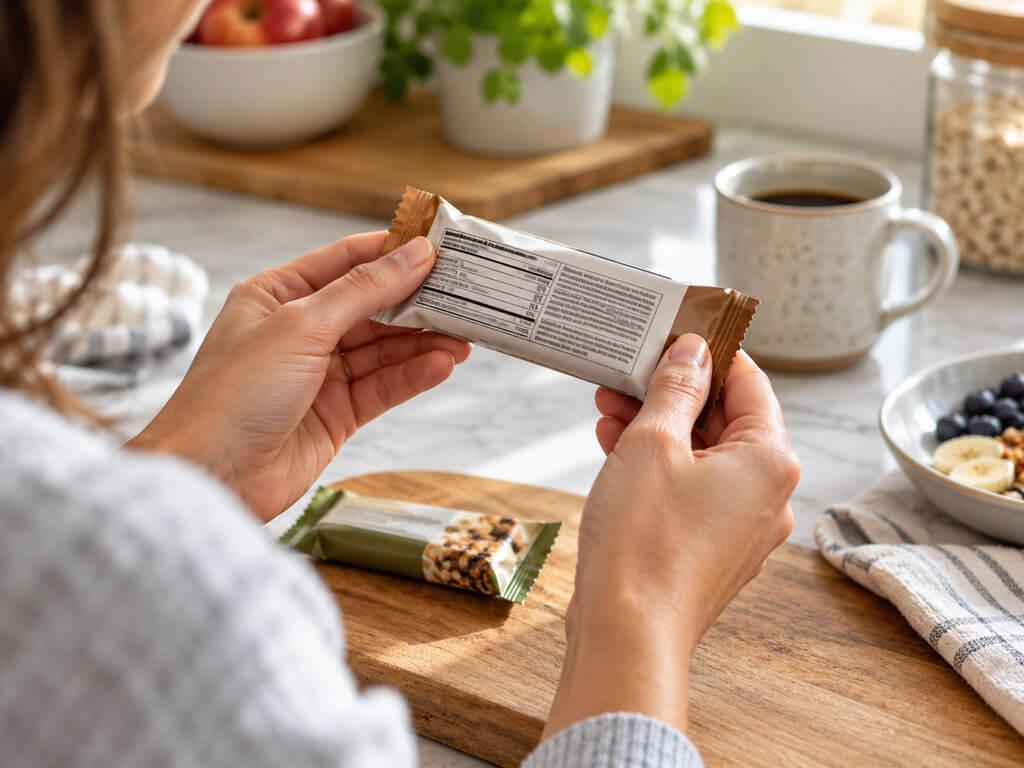
Instead of trying to decide whether a bar is universally “good” or “bad”, run it through these six questions.
1. Does It Actually Give You Much Protein?
This one sounds obvious, but plenty of snacks that look like protein foods don’t contain all that much protein.
The right amount depends on what you expect the bar to do.
A bar with 8 or 10 grams of protein may be perfectly reasonable as a small snack. If you’re relying on it after a workout, during a hectic afternoon or as part of a more substantial mini-meal, you may want something closer to 20 grams.
Current Dietary Guidelines discuss daily protein intake in the range of roughly 1.2 to 1.6 grams per kilogram of body weight, adjusted for individual energy needs. For someone weighing around 154 pounds, that’s approximately 84 to 112 grams of protein over the course of the day.
That helps put a 20-gram bar into perspective: it can make a meaningful contribution, but it isn’t your entire protein strategy.
The takeaway: don’t judge a protein bar by the word “protein” on the wrapper. Check the actual grams.
2. Where Is the Protein Coming From?
Next, look at the ingredient list and find the protein source.
You might see:
- whey protein
- milk protein
- egg protein
- pea protein
- soy protein
- rice protein
- collagen
There isn’t one source that’s automatically best for everyone. Allergies, dairy tolerance, dietary preferences and what you’re trying to get from the bar all matter.
There are also differences in amino acid profiles.
For example, collagen is not considered a complete protein because it does not provide all of the essential amino acids in sufficient amounts, including tryptophan. Collagen has its own useful amino acid profile, but it shouldn’t be treated as interchangeable with a complete protein such as whey when your goal is simply maximizing complete dietary protein.
If you avoid dairy, read carefully here too.
A bar made primarily with collagen or plant protein can still contain milk somewhere else in the recipe—chocolate, whey, casein or another milk-derived ingredient, for example. Check both the ingredient list and the allergen statement.
And what about grass-fed protein?
That tells you something about the sourcing of the ingredient. It doesn’t tell you how many grams of protein you’re getting or automatically make everything else about the bar healthier.
If you want to dig further into that distinction, we have guides on choosing a clean protein powder and whether grass-fed whey protein is better.
3. How Much Sugar Is Really in There?
This is one of the places where labels can trip people up.
- Total Sugars includes all of the sugar in the food, including naturally occurring sugar.
- Added Sugars tells you how much sugar was added during manufacturing.
That distinction matters.
For example, sugar naturally present in milk isn’t the same thing as spooning several teaspoons of cane sugar into a recipe, even though both contribute to Total Sugars.
The FDA Daily Value for added sugar is 50 grams on a 2,000-calorie diet. Using its general label-reading guide, around 2.5 grams or less would fall at 5% DV or below, while 10 grams reaches 20% DV.
We wouldn’t recommend turning those numbers into rigid pass/fail rules for every protein bar. They’re better used as context.
You can also scan the ingredient list for obvious sugar sources, including:
- cane sugar
- honey
- maple syrup
- rice syrup
- molasses
- fruit juice concentrate
- ingredients ending in “-ose”
A little maple syrup in a bar is very different from a recipe where several forms of sugar dominate the ingredient list.
The useful question isn’t necessarily “Does this contain any sugar?”
It’s “How much, and does that amount make sense for what I’m eating?”
4. What Is Making It Sweet?
Once manufacturers lower the sugar in a protein bar, they usually have to replace some of that sweetness with something else.
That’s where things get interesting.
| Sweetener type | Examples | What to know |
|---|---|---|
| Sugars & syrups | Cane sugar, honey, maple syrup, rice syrup, fruit juice concentrate | These generally contribute to added sugar when added to a food. |
| Sugar alcohols | Erythritol, maltitol, sorbitol, xylitol | They can reduce sugar content, but larger amounts may cause gas, bloating or laxative effects in some people. |
| Allulose | Allulose | It provides very few calories and, under current FDA guidance, may be excluded from the Total Sugars and Added Sugars lines. |
| Stevia | Stevia extract, steviol glycosides | High-purity stevia extracts are commonly used to provide sweetness without adding conventional sugar. |
| Artificial sweeteners | Sucralose, aspartame, acesulfame K, saccharin | These are non-nutritive sweeteners and are specifically named in the current Dietary Guidelines. |
And this brings us to a point that gets lost in a lot of “healthy protein bar” conversations:
There are trade-offs.
If a manufacturer dramatically reduces sugar, the sweetness usually has to come from somewhere else.
One person might happily choose stevia or allulose to keep sugar low. Someone else might prefer a little maple syrup and no alternative sweeteners. Another person may avoid sugar alcohols because their stomach makes its feelings on the subject very clear.
There isn’t one answer that works for everyone.
If you’ve ever wondered why one low-sugar bar sits perfectly well while another leaves you regretting your snack decision two hours later, the sweetener blend is worth investigating.
We’ve gone deeper on this in our guides to sugar substitutes and allulose vs. Splenda.
5. Where Is the Fiber Coming From?
Fiber sounds like an automatic win.
Usually, getting enough fiber is a very good thing. But how a protein bar gets to its fiber number matters—especially if you have a sensitive digestive system.
Fiber can naturally come from foods such as nuts, seeds and oats.
It can also be added in concentrated forms such as chicory root fiber or inulin.
Added fibers are not inherently bad, but larger amounts can cause gas and bloating in some people. Research on chicory-derived fibers has found that digestive symptoms tend to increase as the dose goes up.
Unfortunately, the Nutrition Facts panel usually won’t tell you exactly how many grams of the bar’s fiber came from chicory root versus the other ingredients.
That’s why the ingredient list matters.
If you’ve noticed that certain high-fiber bars seem to turn your afternoon into a gastrointestinal science experiment, start comparing their ingredient lists. You may find the same added fiber showing up again and again.
We covered this idea in more detail in our guide to fibermaxxing and increasing fiber without overdoing it.
6. What Else Comes Along With the Protein?
Finally, zoom out.
Two bars can each contain 20 grams of protein and still be very different foods.
Compare:
- calories
- saturated fat
- fiber
- serving size
This doesn’t mean the lowest number always wins.
A 280-calorie bar might make perfect sense when you’re genuinely hungry and need something substantial. A 200-calorie bar might work better as a small afternoon snack.
The same goes for fat.
Ingredients such as nuts, chocolate, coconut and dairy fats can all increase the total or saturated fat content of a bar. That may or may not be a problem depending on the rest of your diet, but it’s worth noticing when you’re comparing two otherwise similar products.
And always check the serving size.
Usually one protein bar equals one serving—but not always. Serving size tells you what the Nutrition Facts numbers refer to. It isn’t an instruction telling you how much you personally should eat.
A Faster Way to Compare Protein Bars
If you’re standing in a store and don’t feel like conducting a 15-minute nutritional investigation, use this shortcut:
| Check | Ask yourself |
|---|---|
| Protein | Is there enough protein for what I want this snack to do? |
| Protein source | Is it a source I tolerate and want? |
| Sugar | How much Total Sugar and Added Sugar am I getting? |
| Sweeteners | What is making this bar sweet, and does my stomach handle it well? |
| Fiber | Is the fiber coming mostly from foods, added fibers or both? |
| Calories & fat | Does this make sense as a snack, workout food or part of a meal? |
| Ingredients | Do I understand what most of this bar is made from? |
That’s usually enough information to make a much better decision.
Does a Short Ingredient List Automatically Mean a Better Bar?
Not necessarily—but it can be useful.
Ingredients are generally listed in descending order by weight, which means the first few ingredients tell you a lot about what makes up most of the food.
If the first ingredients are whey protein, nuts, nut butter and coconut, that paints one picture.
If the first few ingredients are syrups, sugar and various fillers, that paints another.
Still, don’t fall into the trap of assuming:
recognizable = automatically healthy
or
unfamiliar = automatically unhealthy.
Honey has a wonderfully familiar name. It’s still an added sugar when it’s added to a protein bar.
Meanwhile, an ingredient with a scientific-sounding name isn’t necessarily something dangerous.
The best approach is to use the ingredient list with the Nutrition Facts—not instead of it.
You’ve probably also heard the term “ultra-processed food”.
As of October 2026, the U.S. still does not have a finalized official federal definition for ultra-processed foods. Federal agencies reported in August 2026 that a proposed definition had been submitted for review, but the details had not yet been publicly finalized.
So for now, we’d rather look at what a food actually contains than decide whether a protein bar is healthy based on a category name alone.
That’s also the thinking behind our article The Label Says “Clean”… But Is It Really?.
So… What Kind of Protein Bar Should You Choose?
Start with your reason for eating it.
| If your priority is… | Pay closer attention to… |
|---|---|
| More protein | Protein grams and protein source, along with the total calories you’re getting. |
| Less added sugar | The Added Sugars line and sugar-type ingredients. |
| A happier stomach | Sugar alcohols, added fibers and any ingredients you’ve noticed bother you personally. |
| A dairy-free option | The entire ingredient list and allergen statement—not just the main protein source. |
| A substantial snack | Protein, calories, fiber and fat together. |
| Something for your desk, purse or gym bag | Storage requirements. Some bars need refrigeration. |
The “best” bar isn’t necessarily the one with the most protein, least sugar, shortest ingredient list or lowest calorie count.
It’s the one whose overall nutrition and ingredients make sense for your goal, your diet and your digestion.
Now Let’s Put MariGold’s Bars Through the Same Test
Because we make protein bars ourselves, it would be a little strange to spend this entire article telling you to scrutinize labels and then conveniently skip ours.
So let’s look at them.
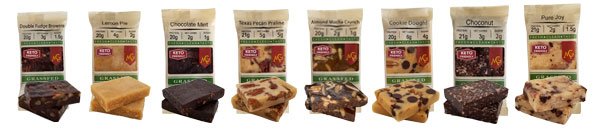
As of October 2026, our four current bars provide 20 to 22 grams of protein per bar, with grass-fed whey isolate listed as the first ingredient on each label.
| Per bar | Texas Pecan Praline | Pure Joy | Cookie Dough! | Chunky Choco Pecan |
|---|---|---|---|---|
| Calories | 267 | 255 | 203 | 284 |
| Protein | 21 g | 21 g | 20 g | 22 g |
| Fiber | 4 g | 6 g | 3 g | 4 g |
| Total Sugars | 5 g | 2.5 g | 4 g | 1.5 g |
| Saturated Fat | 4 g | 13 g | 5 g | 6 g |
| Net Carbs | 5 g | 3 g | 6 g | 3 g |
A few things jump out when you compare them side by side.
First, the protein is remarkably similar. All four provide roughly 20 grams or more.
But the rest of the nutrition isn’t identical.
Calories range from 203 to 284. Fiber ranges from 3 to 6 grams. Saturated fat ranges from 4 grams to 13 grams.
That’s a good real-world example of why we don’t recommend choosing a bar based on one number.
What About the Sweeteners?
None of these four ingredient lists contains a sugar alcohol.
The bars use small amounts of ingredients such as maple syrup, coconut nectar or cane sugar (in the dark chocolate) in combination with stevia extract. Pure Joy also contains allulose.
| Bar | Sugar-type ingredients | Other sweeteners | Chicory root fiber |
|---|---|---|---|
| Texas Pecan Praline | Maple syrup | Stevia extract | Yes |
| Pure Joy | Cane sugar in the dark chocolate, coconut nectar | Allulose, stevia extract | No |
| Cookie Dough! | Cane sugar in the dark chocolate, coconut nectar | Stevia extract | Yes |
| Chunky Choco Pecan | Coconut nectar, maple syrup | Stevia extract | Yes |
Three of the four also include chicory root fiber.
Again, these are trade-offs worth understanding—not details we’re interested in hiding.
If you’re someone who doesn’t tolerate chicory root well, that’s useful information. If you specifically avoid allulose, Pure Joy may not be your flavor. If your priority is keeping sugar very low without using sugar alcohols, you may look at the same ingredient lists differently.
That’s exactly why we think reading labels is more useful than chasing a single definition of the “healthiest” protein bar.
One important note: our current labels list Total Sugars but do not separately list an Added Sugars amount, so we’re not going to pretend we can give you a number the label doesn’t provide.
Formulas and packaging can also change over time. Always check the package you’re actually purchasing if a particular ingredient or nutrition number matters to you.
The Bottom Line
Protein bars can be incredibly convenient.
They’re easy to throw in a work bag, stash in the refrigerator, grab after a workout or keep around for the moment when lunch is still two hours away and your stomach has other plans.
But the words “protein bar” don’t automatically tell you whether something is a great choice.
Flip it over.
Look at the protein. Check where it comes from. Notice the sugar and sweeteners. Pay attention to the fiber source if your stomach is sensitive. Then look at the calories, fat and ingredient list as a whole.
You don’t need a nutrition degree.
You just need to know which few lines on the label actually matter.
FREQUENTLY ASKED QUESTIONS
Everything you need to know about MariGold Whey Isolate Protein Powder
Is it healthy to eat a protein bar every day?
Absolutely, a protein bar can be part of your daily routine! The key is choosing one with quality protein, ingredients that work for you, and a nutritional profile that fits your goals. Think of protein bars as a convenient way to fill nutritional gaps, especially on busy days. They’re not a replacement for a balanced diet, but there’s nothing inherently wrong with enjoying a good one every day.
Do protein bars count as junk food or ultra-processed food?
Not all protein bars are created equal! Some are closer to candy bars with a little protein added, while others are made with quality protein sources, nuts, healthy fats, and thoughtfully chosen ingredients. Rather than judging a bar by its category, flip it over and see what’s actually inside. The ingredient list and Nutrition Facts will tell you much more than the words on the front of the wrapper.
Which protein bars should I avoid?
Be cautious of bars that promise impressive nutrition but don’t quite deliver. Watch for surprisingly low protein, lots of added sugar, or sweeteners and added fibers that don’t agree with your digestion. Also, don’t assume a long ingredient list means a bar is unhealthy—or that a short one guarantees it’s healthy. The best approach is to look at the complete nutritional picture and choose ingredients that fit your needs.
Why do some protein bars upset my stomach?
Ever eaten a protein bar and felt uncomfortably bloated afterward? You’re definitely not alone. Sugar alcohols such as maltitol and sorbitol, along with added fibers like chicory root or inulin, can cause gas, bloating, and digestive discomfort in some people, particularly in larger amounts. If certain bars consistently bother you, compare their ingredient lists. You might discover a common ingredient your stomach doesn’t love.
For more on this topic, see our guide to protein shakes and bloating.
Are protein bars or protein shakes better?
It really comes down to your preferences and what works best for your day. Protein bars are convenient, portable, and give you something satisfying to chew. Protein shakes can be a great option when you want something quick to drink or prefer to customize your protein intake. Neither is automatically healthier. Compare protein quality, added sugars, ingredients, and calories, then choose whichever fits your routine.
Can a protein bar replace a meal?
Occasionally? Sure! A protein bar can be a practical option when you’re short on time and need something more substantial than a typical snack. Just remember that even a high-protein bar may not provide the calories, fiber, vitamins, minerals, and variety you’d get from a balanced meal. Think of it as a convenient backup for hectic days rather than your everyday replacement for breakfast, lunch, or dinner.
- FDA, How to Understand and Use the Nutrition Facts Label
- FDA, Added Sugars on the Nutrition Facts Label
- USDA and HHS, Dietary Guidelines for Americans, 2025–2030
- Federal Register, Food Labeling: Nutrient Content Claims; Definition of Term “Healthy”
- 21 CFR 101.60, Nutrient content claims for the calorie content of foods
- 21 CFR 101.4, Food; designation of ingredients
- FDA, Food Allergen Labeling and Consumer Protection Act
- FDA, Guidance for Industry: Declaration of Allulose and Calories from Allulose
- FDA, Aspartame and Other Sweeteners in Food
- Lenhart A, Chey WD. A Systematic Review of the Effects of Polyols on Gastrointestinal Health and Irritable Bowel Syndrome. Advances in Nutrition, 2017
- Bonnema AL et al. Gastrointestinal tolerance of chicory inulin products. Journal of the American Dietetic Association, 2010
- Paul C, Leser S, Oesser S. Significant Amounts of Functional Collagen Peptides Can Be Incorporated in the Diet While Maintaining Indispensable Amino Acid Balance. Nutrients, 2019
- Food Safety Magazine, FDA, USDA Submit “Ultra-Processed Foods” Definition for Final Review, August 10, 2026
Want to Compare Them Yourself?

Now that you know what to look for on a protein bar label, why not put that knowledge to good use?
At MariGold, we believe a good protein bar should offer more than an impressive protein number. It should be made with thoughtfully chosen ingredients, fit your nutritional goals, and, just as importantly, be something you genuinely look forward to eating. Because even the healthiest-sounding snack isn’t much use if you don’t enjoy it!
Our Protein Bar Starter Sampler makes it easy to find your favorite. You’ll get one of each of our four flavors, all made with grass-fed whey isolate and providing 20–22 grams of protein per bar.
Compare the ingredients, discover the different textures and flavors, and see which ones fit your taste buds and nutritional preferences. It’s an easy way to explore the MariGold lineup before choosing a full box.