For the last few years, protein has been everywhere.
High-protein yogurt. Protein cereal. Protein coffee. Protein snacks. Even foods that never seemed particularly interested in protein suddenly want you to know exactly how many grams they contain.
Now another nutrient wants its turn.
Fiber.
“Fibermaxxing” is one of the latest nutrition trends to take off online, encouraging people to intentionally eat more fiber throughout the day.
And unlike some wellness trends that require mysterious powders, complicated morning routines and a willingness to trust a stranger with excellent TikTok lighting, this one has a pretty solid idea underneath it:
A lot of us probably aren’t eating enough fiber.
But that doesn’t necessarily mean we need to eat as much fiber as humanly possible.
So what exactly is fibermaxxing? Is it actually good for you? How much fiber should you be eating—and what happens when you increase it too quickly?
Let’s get into it.
What Is Fibermaxxing?
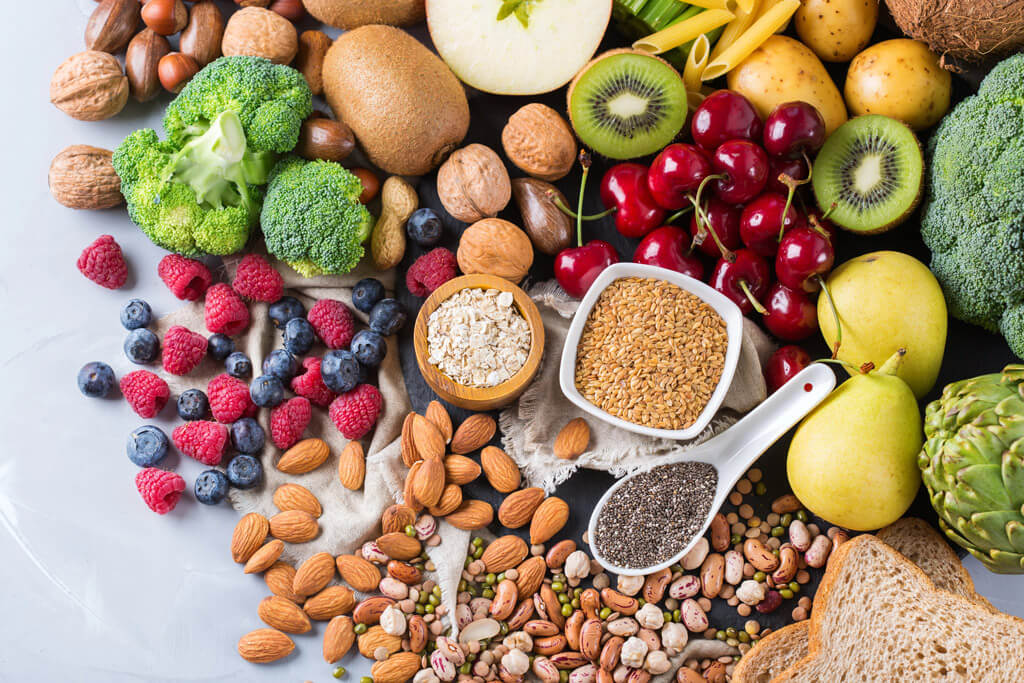
Fibermaxxing is the practice of intentionally increasing your daily fiber intake, usually by eating more fiber-rich foods such as vegetables, fruit, beans, lentils, whole grains, nuts and seeds.
There’s no official medical definition or specific fiber target that turns a diet into a “fibermaxxing” diet. It’s a social-media term rather than a formal nutrition strategy.
In other words, the internet took advice nutrition experts have been giving for decades and added two X’s.
The trend has gained significant attention as fiber begins getting some of the attention protein has received in recent years.
And there’s a legitimate reason people are interested.
Fiber is an important part of the diet, yet many Americans don’t consume as much as recommended. For Nutrition Facts labeling, the FDA’s Daily Value for fiber is 28 grams per day based on a 2,000-calorie diet, although individual needs vary with age, sex and overall calorie needs.
So the idea behind fibermaxxing isn’t particularly radical: Pay more attention to fiber.
It’s the “maxxing” part that deserves a little more scrutiny.
Is Fibermaxxing Good for You?
It can be.
If fibermaxxing means replacing some low-fiber foods with beans, vegetables, fruit, whole grains, nuts and seeds and gradually working toward an appropriate fiber intake, there’s a lot to like about it.
Fiber can support bowel regularity, help with feelings of fullness and contribute to healthy blood cholesterol and glucose regulation. Some forms of fiber are also fermented by gut bacteria, creating compounds that play important roles in the colon and beyond.
But fibermaxxing isn’t automatically healthier simply because someone eats more.
Going from a relatively low-fiber diet to a very high-fiber diet overnight can lead to gas, bloating, abdominal discomfort and changes in bowel habits.
So a better interpretation of the trend might be:
Get enough fiber—not necessarily the maximum possible amount.
How Much Fiber Do You Actually Need?
This is where fibermaxxing can get confusing because social media often turns nutrition into a numbers competition.
Someone hits 30 grams.
Someone else hits 40.
Then suddenly someone is showing you how they squeezed 60 grams of fiber into breakfast.
There isn’t a prize.
The FDA uses 28 grams of dietary fiber per day as the Daily Value on Nutrition Facts labels for a 2,000-calorie diet. Individual recommendations can differ depending on calorie intake, age and sex.
That number is much better viewed as context than as a daily challenge.
If you currently eat very little fiber, gradually moving toward an appropriate intake is likely more sensible than deciding tomorrow will be your first 50-gram day.
What Does Fiber Do for Your Body?
Fiber tends to be famous for one thing: Helping you poop.
And yes, bowel regularity is important.
But fiber does much more than keep things moving.
Dietary fiber is made up of carbohydrates that aren’t fully digested and absorbed in the small intestine.
Depending on the specific fiber, it may:
- add bulk to stool
- hold water in the digestive tract
- support regular bowel movements
- slow digestion
- influence the rise in blood glucose after eating
- help support healthy cholesterol levels
- contribute to fullness
- provide fuel for certain gut microbes
That last one deserves a closer look.
Fibermaxxing and Gut Health: What Happens to Your Microbiome?
We can’t fully digest many types of fiber ourselves. Certain microbes living in the colon can.
When gut bacteria ferment particular fibers, they produce compounds called short-chain fatty acids, or SCFAs.
Three you’ll commonly hear about are:
- acetate
- propionate
- butyrate
These compounds are part of the complicated relationship between diet, the gut microbiome and the cells lining our intestines.
But here’s where fiber gets much more interesting than simply counting grams:
Different fibers can have different effects on the microbiome.
Human research has shown that even different structures of resistant starch can lead to different microbial responses and patterns of short-chain fatty acid production.
So 10 grams of one fiber isn’t necessarily biologically identical to 10 grams of another.
Your gut microbes aren’t reading the Nutrition Facts panel.
Not All Fiber Is the Same
We often talk about “fiber” as though it’s a single substance.
It isn’t.
There are many different fibers with different structures and properties.
One common way of describing them is soluble versus insoluble.
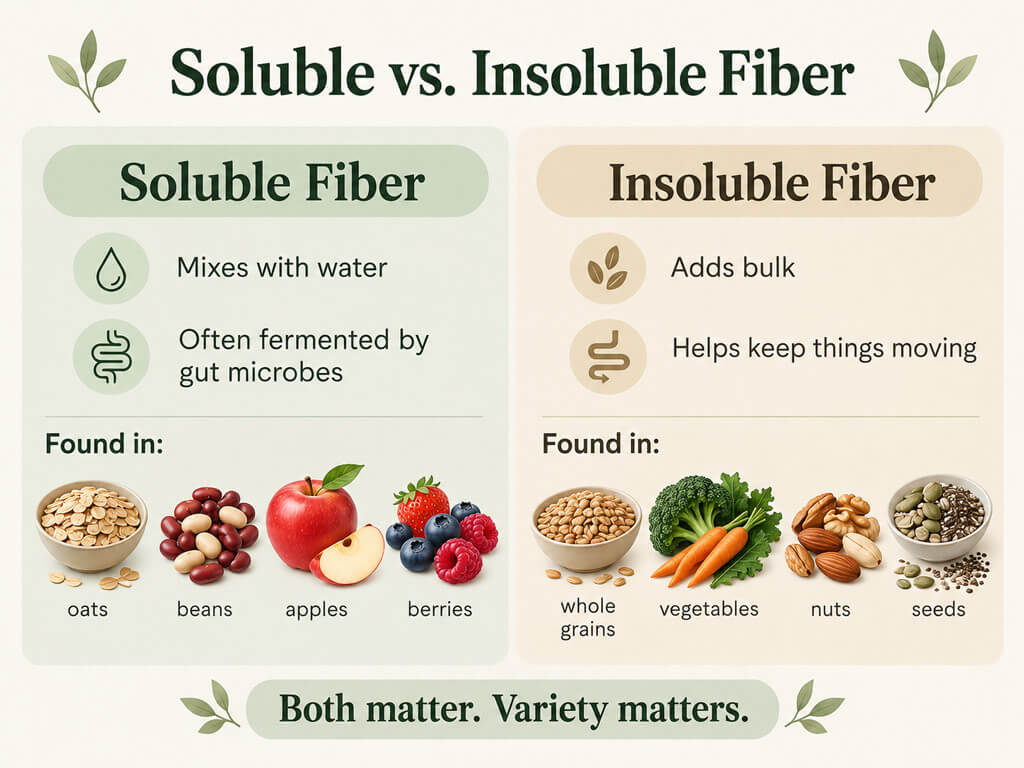
Soluble Fiber
Soluble fiber interacts with water, and some types can form a gel-like substance in the digestive tract.
Many soluble fibers are also fermented by gut microbes.
Sources include foods such as:
- oats
- beans
- lentils
- apples
- berries
Insoluble Fiber
Insoluble fiber doesn’t dissolve in water in the same way.
It can help add bulk to stool and support movement through the digestive tract.
Sources include:
- whole grains
- wheat bran
- vegetables
- nuts and seeds
But soluble versus insoluble doesn’t tell the entire story.
Fibers also differ in characteristics such as fermentability and viscosity, and those differences can change their physiological effects.
That’s why variety matters.
And then there’s another fiber-adjacent carbohydrate getting a lot of attention for gut health: resistant starch.
What Is Resistant Starch?
Resistant starch is starch that resists digestion in the small intestine.
Rather than being completely broken down into glucose and absorbed, some reaches the large intestine, where microbes can ferment it.
Resistant starch naturally occurs in foods including:
- beans and lentils
- some whole grains
- cooked and cooled potatoes or rice
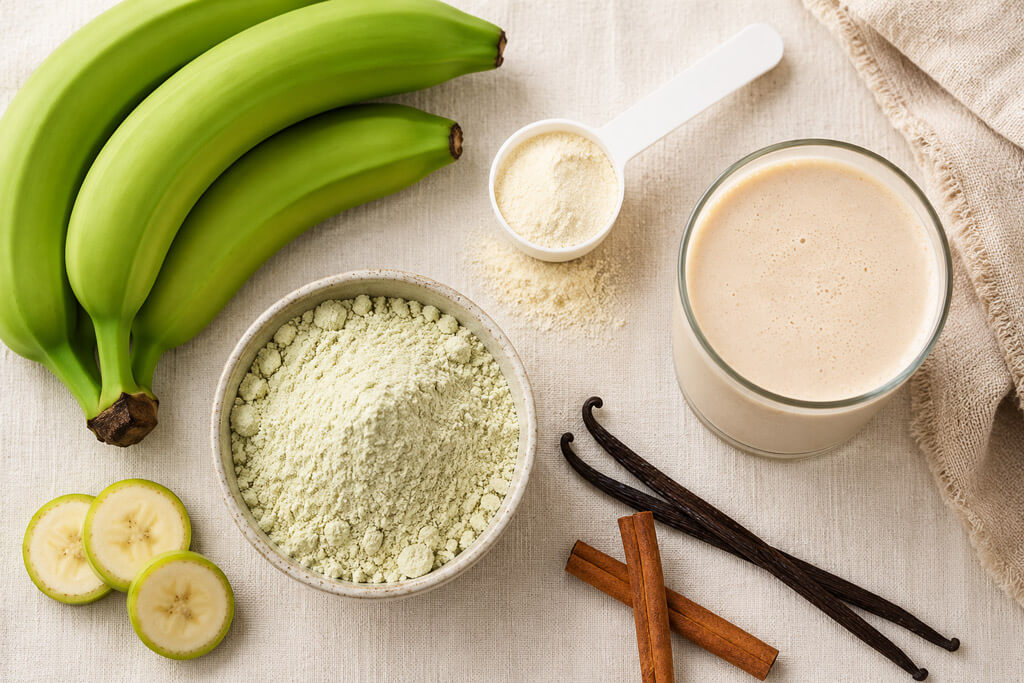
- green bananas
Green bananas are an especially interesting example.
Human digestion research has found that a substantial portion of the starch in raw green banana flour can escape digestion in the small intestine and continue into the colon, where it becomes available for fermentation.
Resistant starch fermentation can also increase production of short-chain fatty acids, although responses can vary considerably between people.
That’s an important point: The same fiber or resistant starch won’t necessarily produce the exact same response in every person.
Can Fibermaxxing Cause Bloating?
Absolutely.
And this may be one of the most important things to understand about the trend.
Fiber can be very good for digestive health while also making your digestive system feel temporarily worse when you increase it too quickly.
That’s not necessarily a contradiction.
Fermentable fibers provide food for gut microbes.
Microbial fermentation can produce short-chain fatty acids—but it can also produce gas.
If your digestive system isn’t accustomed to much fiber and you suddenly introduce large amounts, symptoms may include:
- bloating
- gas
- cramping
- abdominal discomfort
- constipation
- looser stools
Increasing fiber gradually gives your digestive system and its microbial community more time to adjust.
Which means going from coffee and toast one morning to chia pudding, bran cereal, raspberries, flax, psyllium and a bean salad the next probably isn’t the gentlest introduction.
Your gut didn’t sign up for boot camp.
How to Start Fibermaxxing Without Digestive Discomfort
If you’re realizing your current diet doesn’t contain much fiber, you don’t need to completely redesign it tomorrow.
Start by adding fiber to foods and meals you’re already eating.
For example:
- add berries to yogurt
- add chia or ground flax to a smoothie
- add beans to salads, soups or tacos
- swap a refined grain for a whole grain
- add an extra vegetable to dinner
- snack on fruit, nuts or vegetables
- add lentils to soups or sauces
Then give your digestive system time to adjust.
Introducing more fiber gradually rather than making a dramatic increase all at once can help reduce digestive discomfort. Drinking enough fluid is also important as fiber intake rises because many fibers interact with water in the digestive tract.
Think progressive overload for your gut, not fiber CrossFit.
Can You Eat Too Much Fiber?
Yes.
But for most Americans, not eating enough fiber remains the more common issue.
There isn’t one universal fiber ceiling that works for everyone. Tolerance varies with the amount and type of fiber, overall diet, fluid intake, digestive health and individual gut microbiome.
Extremely high fiber intake can cause substantial gastrointestinal discomfort.
Fiber is also filling, so aggressively pushing intake upward could make it harder for some people to consume enough calories, protein or other nutrients.
And people with certain gastrointestinal conditions may need individualized guidance rather than following a blanket “eat more fiber” recommendation.
For example, people with IBS may find that certain fermentable carbohydrates worsen gas, bloating or other symptoms, which is one reason approaches such as a low-FODMAP diet are sometimes used under appropriate guidance.
Once again: More isn’t automatically better.
What Foods Are Best for Fibermaxxing?
The good news is that you don’t need a special fibermaxxing food.
Some of the best sources are ordinary foods that have been around considerably longer than TikTok.
Think:
- beans
- lentils
- chickpeas
- raspberries and other berries
- apples and pears
- avocado
- broccoli
- Brussels sprouts
- peas
- chia seeds
- flaxseed
- nuts
- oats
- barley
- whole grains
- potatoes with the skin
Rather than finding one fiber superstar and eating it constantly, aim for variety.
Different plant foods contain different types of fibers, along with different vitamins, minerals and phytochemicals.
That variety gives you something a gram total alone can’t capture.
Whole-Food Fiber vs. Added Fiber: Does the Source Matter?
This may become one of the more interesting parts of the fibermaxxing trend.
Protein became popular. Then protein appeared everywhere.
Now watch what happens with fiber.
We are likely to see more packaged foods promoting:
- HIGH FIBER
- 10G FIBER
- GUT HEALTH
And that raises an obvious question: Is 10 grams of added fiber the same thing as 10 grams coming from beans, berries, vegetables or whole grains?
Not necessarily.
Whole plant foods provide fiber within a larger nutritional package that can include vitamins, minerals, polyphenols and other plant compounds.
Isolated or added fibers can still provide real physiological benefits.
The FDA doesn’t allow just any non-digestible carbohydrate to be counted as dietary fiber on the Nutrition Facts label. Isolated or synthetic fibers must meet its definition, which includes evidence of a beneficial physiological effect.
So the lesson isn’t: Natural fiber good. Added fiber bad.
It’s: Read beyond the number.
Sound familiar?
Do You Need a Fiber Supplement?
Maybe. But probably not simply because fibermaxxing is trending.
Fiber supplements can be useful for people who have trouble meeting their needs through food or who benefit from a specific fiber for a particular purpose.
Psyllium is one common example.
But a supplement doesn’t bring along everything you’d get from eating berries, vegetables, beans or nuts.
Whole foods also provide vitamins, minerals and other compounds that isolated fiber doesn’t necessarily contain.
Fiber supplements can still be useful tools, but they can also cause gas and bloating, particularly when introduced quickly or in large amounts.
So supplements are a tool. They don’t have to become another thing to “maxx”.
Does Fibermaxxing Help With Weight Loss?
Fiber can play a role in appetite and fullness, but fibermaxxing shouldn’t be treated as a guaranteed weight-loss strategy.
Some fibers can increase satiety, but the effect varies depending on the type and properties of the fiber.
Research has found that certain more viscous fibers can influence appetite more consistently than others, while effects on calorie intake and body weight tend to vary.
So adding fiber-rich foods can absolutely be part of a nutritious eating pattern.
But: More fiber does not automatically equal more weight loss.
That’s another good reason not to treat nutrition as a scoreboard.

Do You Have to Choose Between Protein-Maxxing and Fibermaxxing?
No.
And frankly, we’d prefer if nutrition stopped making us pick teams. Protein and fiber do completely different jobs.
Protein supplies amino acids your body uses to build and maintain tissues, including muscle. Fiber supports digestive function and can help nourish parts of your gut microbial community.
A balanced diet can prioritize both.
Try combinations like:
- Greek yogurt + berries + chia
- eggs + avocado + vegetables
- chicken + lentils or beans
- cottage cheese + berries + nuts
- protein smoothie + berries + flax or chia
- fish + roasted vegetables + a whole grain
Instead of asking: Should I protein-maxx or fibermaxx?
A more useful question may be: What is this meal missing?
If you already have plenty of protein but almost no plants, add some fiber.
If your meal is overflowing with vegetables and grains but contains very little protein, address that instead.
Balance isn’t particularly trendy. It’s just useful.
What About a Fibermaxxing Smoothie?
Interestingly, smoothies are one of the more common things people search for when they’re learning about fibermaxxing.
And smoothies can be an easy way to combine protein and fiber—as long as you don’t turn the blender into a competition.
A simple smoothie might combine:
- a protein source
- berries or another fruit
- chia or ground flax
- a fiber-containing ingredient such as green banana flour
- milk or another liquid
The important part is remembering that multiple fiber-rich ingredients add up quickly.
A smoothie containing fruit, chia, flax, oats, green banana flour and a fiber supplement may look impressively “healthy” on paper while being quite the surprise for a digestive system that isn’t accustomed to it.
Start with reasonable amounts and build from there.
Fiber Deserves the Attention—Just Not the Obsession
Fibermaxxing has a trendy name.
The idea underneath it is actually pretty sensible: Most of us should probably pay a little more attention to fiber.
Fiber does far more than support regular bowel movements. Different fibers can influence digestion, fullness and metabolic responses, while fermentable fibers interact directly with the microbes living in your gut.
Resistant starch adds another fascinating layer to the story. But there isn’t a prize for eating the most fiber.
Just as eating more and more protein isn’t automatically better, neither is piling as much fiber as possible onto every meal.
- Eat a variety of fiber-rich foods.
- Increase your intake gradually.
- Drink enough fluid.
- Pay attention to how your digestive system responds.
And maybe the best thing about fibermaxxing isn’t the “maxxing” part at all.
It’s that a nutrient we’ve largely ignored while obsessing over protein is finally getting some well-deserved attention.
Protein + Fiber Can Share the Spotlight

After an entire article about not turning nutrition into a competition, we’re definitely not going to make you choose Team Protein or Team Fiber.
MariGold Collagen Shake Mixes pair grass-fed collagen peptides with green banana flour, bringing protein and fiber together in one easy shake.
Green banana flour is particularly interesting because green banana starch can resist digestion in the small intestine, allowing some of it to continue into the colon where it becomes available for fermentation.